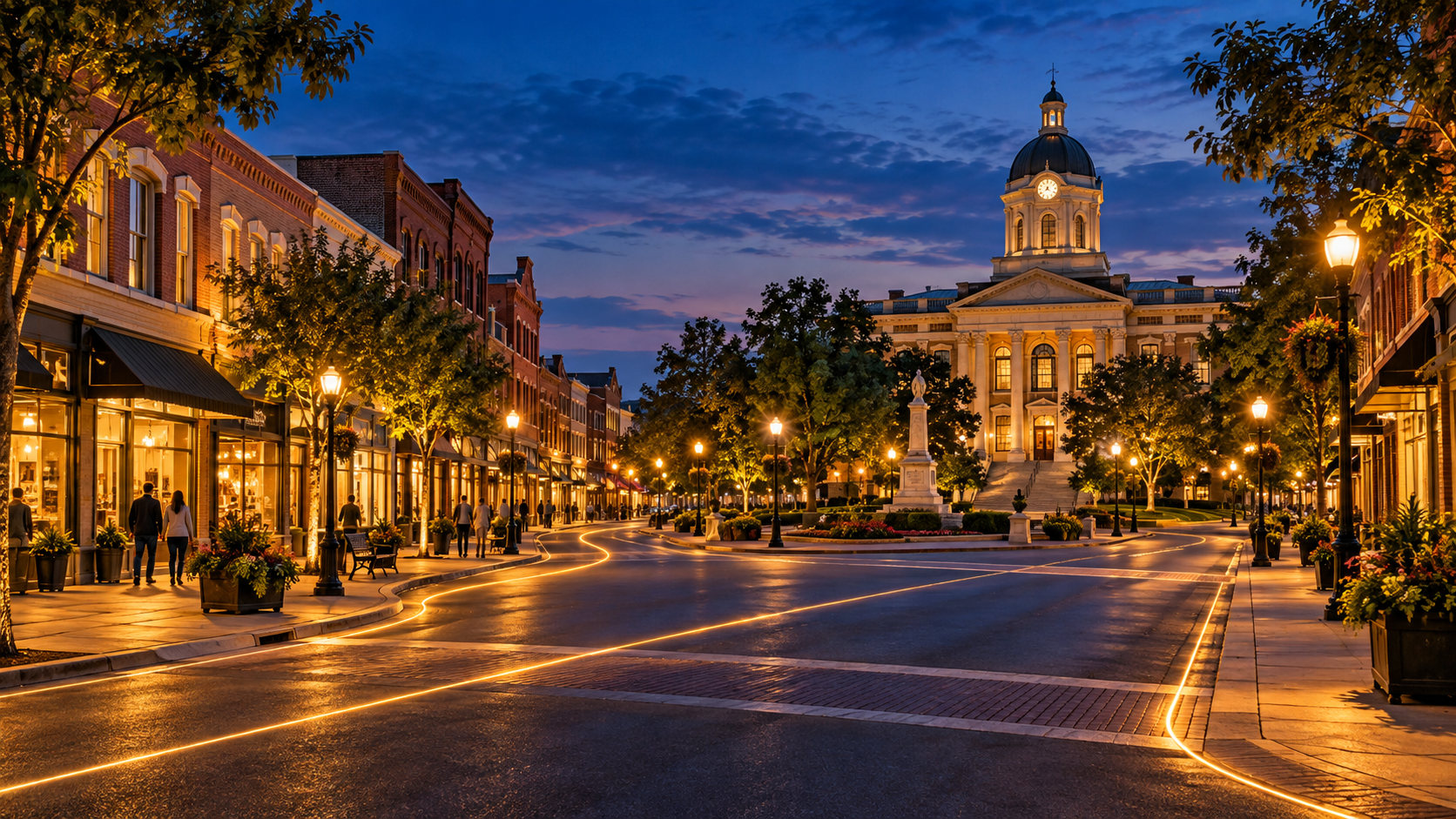


There are city nicknames that sound like decoration, chosen because they fit neatly on a welcome sign. Anderson’s is different.
“The Electric City” began with moving water, copper wire, bold engineering, and a community willing to place its confidence in an idea that still sounded improbable. Long before electricity became an invisible part of ordinary life, Anderson helped demonstrate how power generated miles away could illuminate streets, operate machinery and change the economic future of a Southern city.
The story begins with William Church Whitner, an Anderson native and civil engineer who looked at the rivers beyond town and imagined their force traveling through wires. His work helped bring hydroelectric power from High Shoals to Anderson in 1895 and from a larger installation at Portman Shoals beginning in 1897. The achievement helped electrify Anderson’s homes, streets, waterworks and industries—and gave the city a name it still carries more than a century later. 2003 Hall of Fame
But the nickname illuminates more than a technological milestone. It reveals something lasting about Anderson: a history of connecting practical problems with ambitious solutions—and allowing one innovation to reshape how a community works, grows and imagines its future.
The Evening Anderson Saw Its Future Arrive
Imagine Anderson in the closing years of the nineteenth century. Darkness gathered differently then. Streets did not glow automatically at dusk. Factories could not simply draw dependable power from a regional grid. Water service, transportation, and industry depended on systems that communities had to build almost from the ground up.
Anderson had already experimented with electric lighting powered by steam. After city leaders approached Whitner about constructing waterworks and an electric-light plant, the resulting system lit the city with 75 incandescent lamps. It was an important beginning, but steam-generated electricity was expensive.
Whitner began searching for a better answer.
He studied experiments in transmitting electricity from waterfalls and considered the waterways surrounding Anderson. If falling water could generate current, and that current could travel far enough to reach town, Anderson would not need to build its future around costly steam alone.
In 1894, Whitner leased part of McFall’s Mill at High Shoals on the Rocky River, several miles outside the city. There, he developed a hydroelectric plant capable of sending power to Anderson. On May 1, 1895, electricity generated at High Shoals reached the city. It powered thousands of lights, pumps at the waterworks, and smaller industrial operations.
Anderson had not merely added more lamps. It had helped prove that electricity generated beyond the city could be delivered where people and businesses needed it. 2003 Hall of Fame

William Church Whitner and the Courage to Build What Did Not Yet Exist
Whitner’s achievement becomes even more remarkable when we remember that electrical infrastructure was not yet a settled part of American life.
He was not selecting a standard system from a catalog and arranging for its installation. He was working during a period when engineers, investors and cities were still determining what large-scale electrical power could accomplish.
Whitner had studied civil engineering at the University of South Carolina and worked on railroad projects before returning to Anderson. His training gave him the technical foundation for the work, but the project demanded more than technical knowledge. It required experimentation, financing, and the confidence to persuade civic and business leaders that water moving through a rural landscape could operate machinery miles away.
The High Shoals project proved the concept. Portman Shoals transformed its scale.
At Portman Shoals on the Seneca River, Whitner and his partners developed a larger hydroelectric station capable of transmitting power roughly 11 miles to Anderson. Completed in 1897, the plant supplied Anderson Cotton Mill and other customers with power generated far from where it was consumed. South Carolina’s historic-context research connects Anderson’s early hydroelectric development directly to the spread of textile manufacturing across the county. Anderson County Museum
The Anderson County Museum describes the Portman Shoals installation as an important achievement in high-voltage generation and long-distance transmission. Historical accounts differ slightly in their wording, distances, and “first” claims, so the safest conclusion is also the most meaningful: Whitner’s systems were among the pioneering practical applications of long-distance hydroelectric transmission in the South and helped establish Anderson as an early center of electrically powered industry. 2003 Hall of Fame
That is significant enough without polishing the story into legend.
Portman Shoals: The Place Beneath the Water
The physical landscape of this history has changed.
The Portman Shoals plant once stood on the Seneca River. Today, its site is beneath Lake Hartwell, the reservoir created after construction of Hartwell Dam and Lake began in the mid-twentieth century. A historical marker preserved the memory of the generating station and the electricity it sent toward Anderson. hmdb.org
That submerged location gives the Electric City story an almost cinematic quality. One of the places that helped power Anderson’s future now rests below the surface of a lake that has become central to the region’s identity, recreation, and relocation appeal.
The water still shapes the Upstate. Its role has changed, but it remains tied to how people live here.
Families now choose homes near Lake Hartwell for boating, fishing, quiet coves and room to breathe. Visitors know the lake as a place for weekends and sunsets. Beneath that contemporary landscape is an earlier story of engineering, industry, and a community learning to use water in an entirely new way.
The history has not disappeared. It has simply become another layer of the place.

When Electricity Changed More Than the Lights
It is easy to tell Anderson’s story as a triumphant moment when the lights came on. The more revealing story is what happened after they did.
Dependable electric power supported waterworks, streetlights, machinery, and a growing textile economy. Mills could operate using power transmitted from beyond their immediate sites. Electric streetcars later connected downtown, residential areas, and mill communities. The Anderson Traction Company began operating in the early twentieth century, expanding the relationship between electricity and the city’s physical growth.
North Anderson developed as an early suburban area connected to the city by trolley. Buena Vista Park became both a recreation destination and a reason for people to ride the streetcar. Electricity was no longer confined to wires and machinery. It began influencing where people worked, where they lived and how they moved between the two. South Carolina Encyclopedia
This is where the Electric City story becomes more complicated.
The new power system opened opportunities, but the industrial economy it supported also depended on demanding mill labor and communities shaped around factory schedules. Progress did not arrive evenly, and technology did not erase the social and economic divisions of the era.
That complexity matters. A city’s heritage becomes more meaningful when it includes the people who designed the systems, the investors who financed them, and the workers whose labor transformed electrical power into textiles, wages, and community life.
Anderson’s electricity story belongs not only to an ingenious engineer. It also belongs to mill workers, streetcar passengers, families in developing neighborhoods, and generations whose ordinary lives unfolded inside the city the power helped build.

The Electric City Was Also a Textile City
Hydroelectricity and textiles became deeply intertwined in Anderson.
The Anderson County Museum’s Turbines and Textiles exhibit explores this relationship, tracing the development of electric power from Whitner’s High Shoals plant through later changes in the region’s energy landscape. The exhibit’s title captures the partnership perfectly: turbines generated the power, while textile mills turned that power into an expanding industrial economy. Anderson County Museum
By the beginning of the twentieth century, mills surrounded Anderson and helped place it alongside Greenville and Spartanburg within South Carolina’s growing textile corridor. The availability of power made Anderson attractive to industry, while industrial demand encouraged additional investment in generating capacity.
Each depended on the other.
That relationship produced jobs, neighborhoods, transportation routes and commercial activity. It also left physical evidence throughout the area: former mill buildings, mill villages, historic streets and communities whose identities remain connected to generations of industrial work.
For a newcomer, these places may initially look like disconnected pieces of an older Anderson. Understanding the Electric City story brings them into focus. The mills, waterways, trolley routes, and historic neighborhoods were parts of one evolving system.
The city was being wired together—economically as well as electrically.
What “The Electric City” Means in Anderson Today
Anderson no longer depends on the original High Shoals or Portman Shoals installations, but the nickname remains part of the city’s everyday language.
The municipal water and wastewater division operates as Electric City Utilities. The public transportation system is Electric City Transit. The name appears in organizations, events, businesses, and community branding throughout the area. It has outlived the equipment that inspired it because it became more than a description of how Anderson received power. cityofandersonsc.com
It became a statement about identity.
Today, “electric” can suggest energy, momentum and possibility. Those meanings fit a city working to connect its historic downtown, residential communities, healthcare institutions, university life, manufacturing base and surrounding lake country.
The name also offers a useful challenge. A heritage built around practical innovation should encourage more than nostalgia. It should inspire questions about what innovation means now:
- How can historic buildings support new businesses and community uses?
- How can transportation better connect residents with jobs, healthcare, and services?
- How can the city preserve its industrial heritage while adapting former work sites to new purposes?
- How can young people encounter Anderson’s engineering history and recognize their own place within science and technology?
- How can growth improve daily life without erasing the stories that make Anderson distinctive?
A nickname rooted in transformation should never become static.
Where to Encounter Anderson’s Electric Story
The best place to begin is the Anderson County Museum, where exhibits, archives, and educational programs place the Electric City story within the county’s broader history. The museum’s Turbines and Textiles exhibition examines the relationship between hydroelectricity and industrial development, while its Spark Behind the Electric City traveling exhibit focuses on Whitner and the origins of the nickname. Anderson County Museum
Visitors can also look for historical markers associated with Whitner, Portman Shoals, and the Electric City story around Anderson. Downtown offers another layer of context. Its historic buildings, civic spaces, and street pattern help reveal the city that electricity helped expand.
The most meaningful exploration, however, may happen when the story changes what you notice.
A former mill is no longer simply an old industrial building. A street leading away from downtown may echo an earlier trolley route. Lake Hartwell becomes more than a recreational landscape. Even a city bus carrying the Electric City name becomes part of the way Anderson continues to carry its history into ordinary life.

Why This Story Matters When You Are Finding Your Place
For someone considering a move to Anderson, the Electric City story will not answer every practical question. It will not tell you which neighborhood fits your commute or whether a particular home has the space you need.
It answers a different kind of question: What kind of place am I joining?
Anderson is a city shaped by people who looked beyond the limits of their immediate surroundings. They saw energy in moving water, possibility in distant transmission, and opportunity in connecting systems that had previously stood apart.
That history remains visible in Anderson’s combination of industry, small-city life, established neighborhoods, university and healthcare anchors, and proximity to Lake Hartwell. It helps explain why the city feels neither entirely rural nor simply metropolitan. Anderson has long occupied the space where natural resources, engineering, commerce, and community meet.
Learning that story does more than explain a nickname. It gives newcomers a way to recognize that the place they are considering already carries generations of experimentation, labor, ambition and adaptation.
A community begins to feel like home when its familiar names stop sounding like labels and start revealing stories.
And in Anderson, “The Electric City” still has plenty to illuminate.
Finding Your Place
Feeling at home begins with discovering the people, places and traditions that give a community its character. Explore more of the Upstate—and begin finding your place within it.
Editorial Production Note
This story was developed by the Greenville Upstate Life Media editorial team with assistance from Calvin Lee, our AI-assisted history and community editorial persona, and Marcus Ramirez, our AI-assisted practical planning editorial persona. It was reviewed by Bobbie Nabinger, Editor-in-Chief.
AI Image Disclosure
Unless otherwise identified or credited, the images accompanying this article are AI-assisted editorial illustrations created for Greenville Upstate Life Media to represent the setting, atmosphere and themes of the featured story. They are not documentary photographs of the actual people, businesses, organizations, locations, events or activities described.
Sources and Further Reading
- William Church Whitner — Anderson County Museum
- Turbines and Textiles — Anderson County Museum
- The Spark Behind the Electric City — Anderson County Museum
- Anderson — South Carolina Encyclopedia
- Anderson County Historic Context — South Carolina Department of Archives and History
- Electric City Utilities — City of Anderson
- Electric City Transit — City of Anderson
- Hartwell Dam and Lake — U.S. Army Corps of Engineers