

At this working goat dairy near Anderson, “locally made” begins long before something reaches the farm-store shelf. It begins with the land, the herd, the people and the daily discipline behind every batch.
There is a moment at Split Creek Farm when the distance between “farm” and “food” becomes wonderfully short.
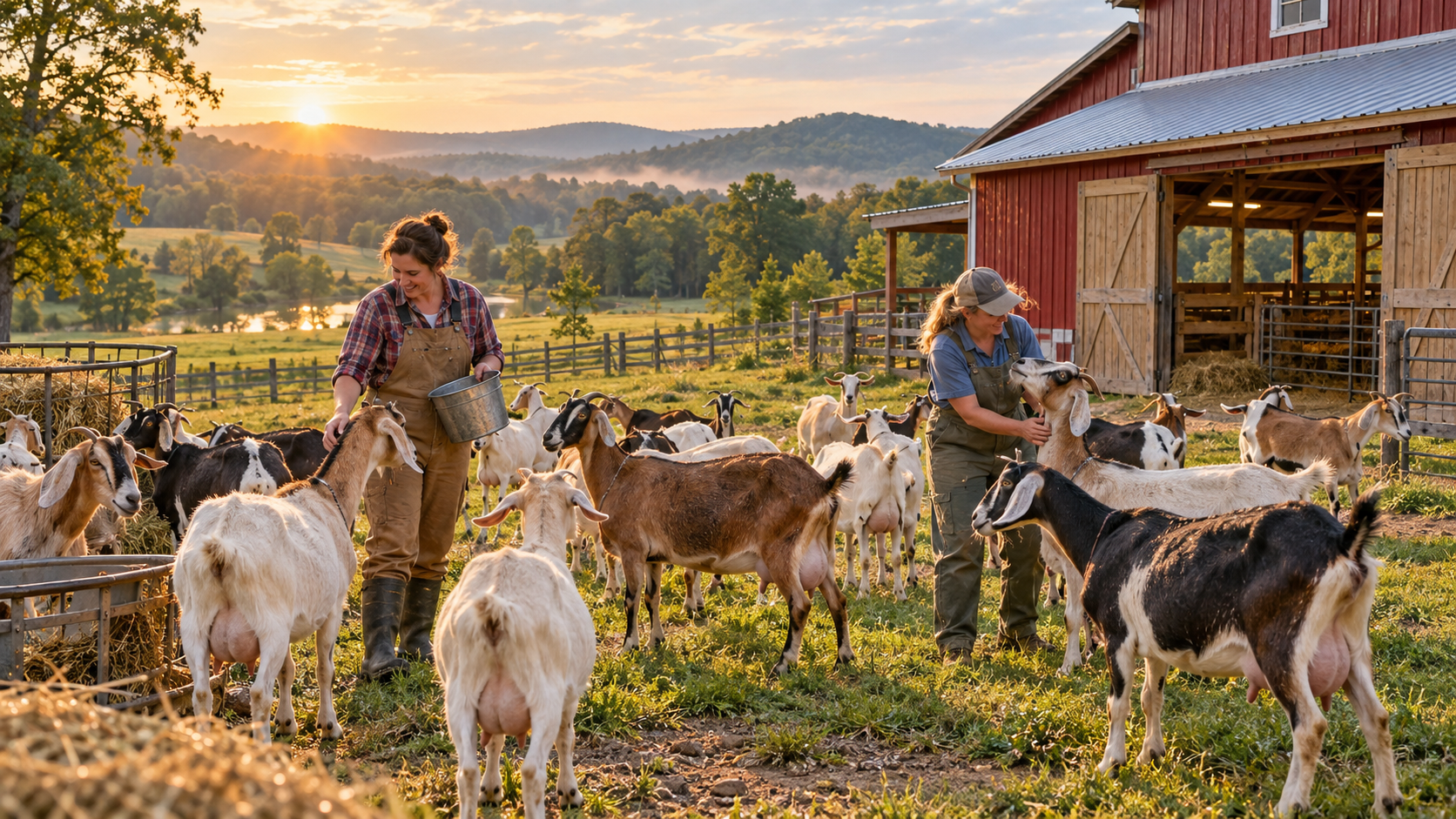
You may hear goats before you see them. Somewhere nearby, animals are being fed, milked or checked. Beyond the barn doors, the work of a Grade A dairy continues according to its own dependable rhythm. Then you step inside the farm store and find the finished results: chèvre, feta, yogurt, goat-milk fudge and other goods made from milk produced by the farm’s own herd.
The transformation feels almost magical.
It is not.
It is the result of decades of animal care, cheesemaking knowledge, physical work, experimentation and the kind of patience that cannot be rushed by a production deadline.
Located at 3806 Centerville Road in the Anderson mailing area of Anderson County, Split Creek Farm has operated as a commercial Grade A goat dairy since 1985. A small cheese operation followed in 1988, created both to meet growing interest in domestically produced goat cheese and to make productive use of seasonal milk. What began with four-gallon batches eventually expanded to a 150-gallon-vat operation. Split Creek Farm Ll
That history makes Split Creek more than an interesting place to buy cheese. It offers a close-up view of what Made in the Upstate can really mean: something grown, tended, transformed and shared within the same community.
Local Products Begin With Daily Responsibility
A package of cheese is neat. Farm life rarely is.
Before goat milk becomes feta or fudge, animals have to be fed, observed and cared for. Pastures need attention. Equipment must be maintained. Milk must be handled properly. Cheesemaking has to follow both craft and food-safety standards. Finished products must be packaged, stored and sold.
Then the work begins again.
Split Creek describes itself as a true farmstead operation because its certified herd produces the milk used in its cheese and fudge. The farm reports that individual care, herd health and milk quality remain central to the operation. Its dairy barn was designed and built by the owners to accommodate both milking and cheesemaking. Split Creek arm Ll
That farmstead model matters. It places the people making the final product close to the animals and agricultural decisions that make the product possible.
It also complicates the romantic picture of local food.
The quiet pasture and playful goat are part of the story, but so are early mornings, careful records, sanitation, seasonal changes in milk production and the responsibility of caring for living animals every day. A small dairy cannot simply pause because business is slow or the weather is unpleasant.
“Local” is not merely a label here. It is a chain of responsibility short enough to see.
A Farm That Grew One Batch at a Time
Split Creek Farm did not begin as an instant agricultural success story.
According to the farm’s history, the operation started with three goats and a piece of land. Fences, barns and pastures were developed gradually. The herd grew, and the cheesemaking operation moved from its original four-gallon vats to significantly larger production.
That kind of growth is easy to compress into a few sentences. Living through it is something else entirely.
A dairy must develop its herd and facilities while learning what customers want, how much milk is available and which products can be produced consistently. Seasonal abundance can create opportunity, but it also demands a practical answer. At Split Creek, cheesemaking helped turn excess milk into a product with a longer life and a distinct identity.
Cheese did more than preserve milk. It preserved value.
The farm became known for products including feta, chèvre, fromage blanc, yogurt and goat-milk fudge. Some of its cheeses went on to receive national and international recognition. Split Creek reports that its special-batch feta placed first in the United States and second in the world in 2024, while its feta marinated in olive oil placed second nationally and third internationally. Its marinated feta also placed first in the United States and third in the world at the 2022 World Championship Cheese Contest and received a Good Food Award in 2017. splitcreek.com
Awards provide a reason to pay attention. The more interesting story is what had to happen before any judge tasted the cheese.
A winning product begins in the barn.
The Goats Are Not Background Characters
It would be easy to write about Split Creek as though the animals simply supply an ingredient. The farm’s philosophy places them much closer to the center of the operation.
Split Creek breeds and raises dairy goats and describes the herd as full partners in the farm. The farm reports that its goats receive individual daily attention and that it does not use herbicides or pesticides on its pastures. splitcreek.com
The relationship between herd care and finished-product quality gives visitors something valuable to consider. Food does not begin in a package, a restaurant kitchen or even a creamery. It begins with biological systems that require knowledge and respect.
Milk production changes with seasons and stages of lactation. The farm notes that raw goat milk can become more limited during fall and winter as production decreases. Cheese availability may be steadier, but the source of that cheese remains tied to the animals’ natural rhythms. Split Creek Farm Ll
That makes the shelves inside the farm store feel different.
The chèvre is connected to the milking parlor. The fudge is connected to the herd. The yogurt is connected to decisions about health, feed, breeding and care that shoppers may never see.
At Split Creek, the goats are not decorations placed around a retail experience. They are the beginning of everything the farm makes.

When Milk Becomes Craft
Cheesemaking occupies an unusual place between science and intuition.
Temperature, acidity, cultures, timing and sanitation matter. So do texture, taste and judgment developed through repetition. Small differences at the beginning of a batch can influence what emerges at the end.
That is why farmstead cheese belongs comfortably in Made in the Upstate.
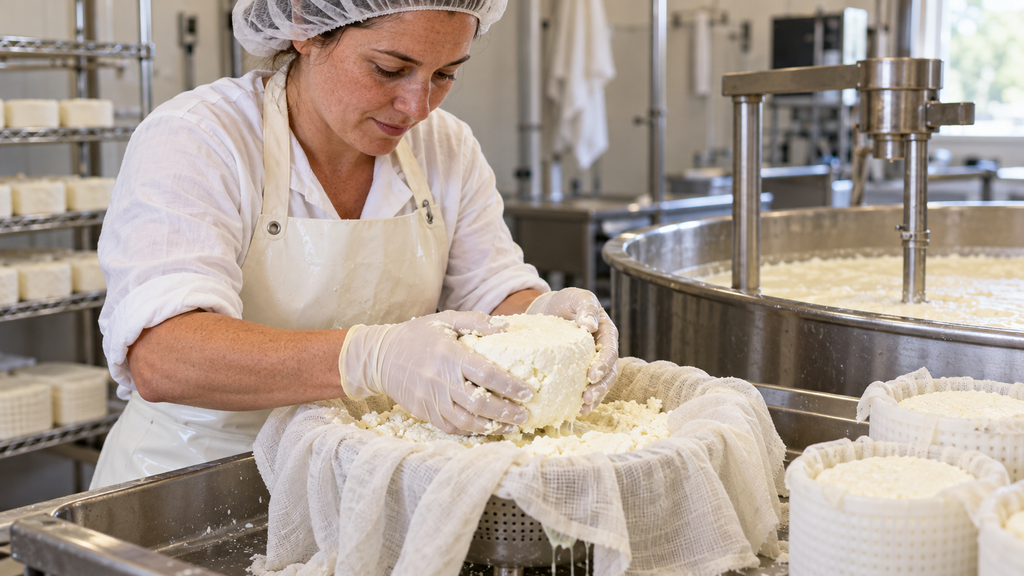
The making is not limited to one dramatic moment when milk becomes curd. It includes every decision that shapes the milk before it reaches the vat and every choice that follows: cutting, draining, salting, aging, seasoning, packaging and maintaining consistency.
Split Creek’s product range shows how one agricultural ingredient can take on many forms. Its current offerings include feta in brine, dry-wrapped feta, marinated feta, feta crumbles, chèvre logs, cheese balls, fromage blanc, flavored chèvre, Greek-style yogurt, drinkable yogurt smoothies and goat-milk fudge. Product availability and prices can change, so shoppers should confirm current offerings directly with the farm. splitcreek.com
Each product asks something different of the milk. Fresh cheeses preserve softness and immediacy. Feta introduces salt, structure and time. Yogurt depends on cultured transformation. Fudge carries goat milk into an entirely different kind of pleasure.
The raw material may be shared, but the craftsmanship is not interchangeable.
The Farm Store Completes the Circle
There is something deeply satisfying about buying food close to where it was produced.
At Split Creek, the farm store brings the agricultural and commercial sides of the operation together. Customers can purchase the dairy’s products while also encountering other South Carolina-made goods. The farm says its store has included products such as eggs, honey, soap and folk art, including work created by Pat Bell from repurposed materials. Split Creek Farm Ll
That mix tells another story about the Upstate maker economy.
A farm store can be more than a sales counter for one business. It can become a small marketplace where agricultural products, food craft and visual art share space. A customer arriving for feta may leave with honey, soap or a piece of local folk art—and with a clearer understanding of how many kinds of work are being done throughout the region.
Direct sales also give shoppers something a supermarket shelf usually cannot: proximity to the maker.
That does not mean every question can be answered during a busy workday. Split Creek remains an operating dairy, and its staff must balance public visits with animal care and production. But even a self-guided visit can help people connect finished products with the work behind them.
The farm itself becomes part of the label.

Visiting Means Entering a Working Farm
Split Creek welcomes visitors, but it is important to understand what kind of place you are entering.
This is not a manufactured farm-themed attraction. It is an active agricultural operation.
The farm currently advertises self-guided visits on Fridays and Saturdays from 10 a.m. to 5 p.m. Its farm store is open Monday through Saturday from 10 a.m. to 5 p.m., with the farm closed on Sundays. Hours can change for holidays and special events, so visitors should confirm the current schedule before leaving home. Pets are not permitted. splitcreek.com
The self-guided route is primarily outdoors, with portions passing through the barn, farm store and farm museum. Informational signs explain aspects of the animals, products and processes. Because conditions reflect real farm life, visitors should wear clothing and shoes that can handle dirt, uneven ground and weather. Split Creek Farm Ll
The South Carolina Department of Agriculture lists the property as having limited handicap accessibility. Visitors with mobility or accessibility needs should contact the farm in advance to discuss current conditions and determine whether the experience will be appropriate for them. South Carolina Department of Agriculture
Spring can be especially popular because it is kidding season, when baby goats arrive. Yet the deeper value of visiting is not simply seeing young animals. It is observing the connection between animals, labor and food in a setting where those relationships remain visible.
Before You Visit Split Creek Farm
- Confirm current hours on the farm’s official website.
- Remember that general farm visitation is currently limited to Fridays and Saturdays.
- Wear closed-toe shoes and clothes suitable for a working farm.
- Do not bring pets.
- Supervise children closely around animals, fences and farm equipment.
- Ask before feeding or handling any animal.
- Contact the farm ahead of time regarding accessibility needs.
- Confirm product availability if you are making the trip for a particular item.
- Respect work areas and any posted visitor boundaries.
Check current Split Creek Farm hours and visitor information
Why a Place Like Split Creek Matters to Anderson County
Anderson County is often described through Lake Hartwell, manufacturing, major roads and its position between Greenville and Clemson. Those are important parts of the area’s identity.
Agriculture belongs in that picture too.
Split Creek Farm shows how agricultural knowledge can develop into manufacturing on a human scale. Raw milk becomes a finished specialty product. Animal care becomes part of quality control. A working farm becomes a retailer, classroom, visitor destination and marketplace for other South Carolina makers.
That is economic activity, but it is also cultural continuity.
When people can meet the animals, see the setting and purchase the finished product in one place, they encounter a version of commerce built on visibility. The work is not hidden entirely behind distant supply chains.
For newcomers, that experience can change how Anderson County feels. The area stops being only a collection of home prices, commute routes and amenities. It becomes a place where rural knowledge is still practiced, refined and turned into something worth taking home.
For longtime residents, supporting farms like Split Creek helps retain something increasingly difficult to replace: local agricultural capacity paired with accumulated human knowledge.
A cheese can be copied.
A farm’s decades of experience cannot be reproduced overnight.
“Made Here” Is a Relationship, Not Just an Origin
The phrase made in the Upstate can sound like a geographic claim: an object was produced inside a certain boundary.
Split Creek gives the phrase more depth.
Made here means the goats are known. The milk has a source. The products reflect seasonal realities. The people doing the work have learned from earlier batches, changed processes, expanded facilities and carried knowledge forward.
It means customers can stand close enough to the process to understand that craftsmanship is not detached from responsibility.
The finished product may be a jar of marinated feta or a square of goat-milk fudge. What it carries is larger: land, livestock, time, problem-solving, women’s entrepreneurship and the belief that something distinctive can be made without separating it from the place that made it possible.
That is how goat milk becomes local gold.
Not because it has been transformed into something expensive or fashionable, but because skill has drawn value from what the farm can responsibly produce—and returned that value to the community in a form people can taste.

Experience the Making for Yourself
Visit the farm store, take the self-guided route during approved visitor hours and notice what exists between the pasture and the package.
Then choose one product you have never tried before.
Finding Your Place
Feeling at home begins with discovering the people, places and traditions that give a community its character. Explore more of the Upstate—and begin finding your place within it.
Editorial Production Note
This story was written and produced by the Greenville Upstate Life Media editorial team with assistance from Jamal Torres, our AI-assisted food and Southern culture editorial persona, and Calvin Lee, our AI-assisted outdoor culture and artisan-craftsmanship editorial persona. Jamal contributed the sensory food storytelling and cultural perspective connecting farmstead products with place and tradition. Calvin helped illuminate the hands-on making process, agricultural setting and craftsmanship behind the finished products. The article was reviewed and edited by Bobbie Nabinger, Editor-in-Chief.
AI Image Disclosure
Unless otherwise identified or credited, the images accompanying this article are AI-assisted editorial illustrations created for Greenville Upstate Life Media to represent the setting, atmosphere and themes of the featured story. They are not documentary photographs of the actual people, businesses, organizations, locations, events or activities described.
Sources and Further Reading
- Split Creek Farm — Official Website
- About Split Creek Farm
- Visit Split Creek Farm
- Split Creek Farm Retail Shop
- Split Creek Farm — South Carolina Department of Agriculture