


Open the refrigerator door almost anywhere in the South, and there is a good chance you will spot it: a squat jar, a bright yellow lid, and that familiar black-and-yellow label tucked beside the pickles and mustard.
Duke’s Mayonnaise is so thoroughly woven into Southern kitchens that it can feel as if it has always been there—waiting for the first summer tomato, the next bowl of potato salad, or a plate of deviled eggs headed to a family gathering.
But that jar holds more than mayonnaise.
It holds the story of a Greenville woman who saw opportunity in a difficult moment, built a business from her home kitchen, and created a flavor that would travel far beyond the Upstate. It connects a World War I training camp, downtown tea rooms, a brick building beside the Reedy River, and one of the South’s most fiercely defended culinary loyalties.
More than a century later, the story still belongs to Greenville—and you can follow much of it through the city today.
It Started With a Sandwich—and a Ten-Cent Sale
In 1917, Greenville was changing quickly.
Camp Sevier had opened near the base of Paris Mountain as the United States entered World War I. Thousands of soldiers arrived to train, bringing an enormous new population into a city already shaped by textile mills, rail lines, merchants, and rapid growth.
They also brought enormous appetites.

AI-assisted editorial illustration; not a historical photograph.
From her Greenville home, Eugenia Duke saw a practical opportunity. With help from her daughter, Martha, she began preparing sandwiches to sell through Army canteens serving the soldiers. The fillings were familiar—chicken salad, pimiento cheese, egg salad, and other satisfying combinations—but the homemade mayonnaise holding everything together made those sandwiches especially memorable.
They sold for a dime apiece. According to Duke’s official history, Eugenia earned about two cents on each one.
Two cents may not sound like the beginning of a food empire. Yet those small profits accumulated one sandwich at a time. In 1918, after selling her 11,000th sandwich, Eugenia purchased a delivery truck and expanded her reach.
Picture the rhythm of that early business: bread lined across a kitchen workspace, bowls of sandwich filling, jars of freshly prepared mayonnaise, paper wrapping, and another order waiting to be delivered.
Long before “entrepreneurship” became a familiar career path, Eugenia was solving the problems every growing business eventually encounters—production, transportation, customer demand, and how to make enough of the thing people kept asking for.
The soldiers may have purchased the sandwiches, but it was the mayonnaise they remembered. Duke’s says some wrote to Eugenia after leaving Camp Sevier, asking for recipes and jars of the spread that had given her sandwiches their distinctive flavor.
The side ingredient was becoming the main attraction.
From a Greenville Kitchen to the Duke Tea Room
By 1920, Eugenia’s sandwiches were reaching local drugstores and grocery stores. Her growing food business soon found a prominent downtown home in the Duke Tea Room at the Ottaray Hotel.
The hotel once stood on North Main Street, where the Hyatt Regency Greenville is located today.
The tea room gave Eugenia’s cooking a public stage. Diners could sit down for her sandwiches, meals, and baked goods while downtown Greenville moved around them. China clinked, conversations carried across the room, and Eugenia’s mayonnaise continued quietly winning admirers.
Historical accounts portray Eugenia as far more than a gifted cook. As her company grew, she served as its president, general manager, superintendent, auditor, traveling salesperson, and public speaker.
That is one of the most compelling parts of her story. Eugenia did not simply happen upon a popular recipe. She recognized demand, built distribution, promoted her product, and kept adapting as the business outgrew each previous version of itself.
The tea room eventually closed as demand for the mayonnaise pushed the business in a different direction. By 1923, Duke’s was bottling the mayonnaise as a product of its own, and Eugenia left the sandwich business behind to concentrate on the condiment people wanted to take home.
The Brick Building Beside the Reedy River
If you walk through downtown Greenville, past Falls Park and along the Reedy River, you can still find one of the most tangible pieces of the Duke’s story.
The Wyche Pavilion—with its weathered brick, open-air arches, and enviable position beside the water—began life as a paint shop for the Greenville Coach Factory. During the mid-1920s, it became Duke’s first large-scale mayonnaise plant.
It is easy to pass the building now and see only an atmospheric downtown landmark or elegant event venue. But imagine it in its working years: jars moving through production, orders leaving the building, and Eugenia’s once-homemade recipe being prepared for an expanding market.
That transformation feels especially Greenville. The city is full of places where an older industrial life remains visible inside a newer one. At Wyche Pavilion, the architecture preserves the outline of both: Greenville’s manufacturing past and the unlikely condiment business that once operated beside the river.
Demand eventually became more than Eugenia could manage alone. On February 9, 1929, she sold the mayonnaise business to the C.F. Sauer Company and remained involved as its chief salesperson.
Her recipe, however, did not leave the Upstate behind. Duke’s says its flagship mayonnaise is still made according to Eugenia’s original recipe. Today, Duke’s continues to be produced in Mauldin, keeping part of the brand’s manufacturing story inside Greenville County.
The scale has changed dramatically—from carefully wrapped sandwiches in a home kitchen to modern production facilities—but the geographic thread remains remarkably intact.
Four Places Where Greenville’s Mayo History Lives On
Greenville has embraced the story with an experience that is equal parts food tour, history lesson, and affectionate local eccentricity.
Eugenia Duke’s Unofficial Mayo Guide includes 20 culinary stops featuring dishes made with Duke’s, along with four places connected to the company’s Greenville history.
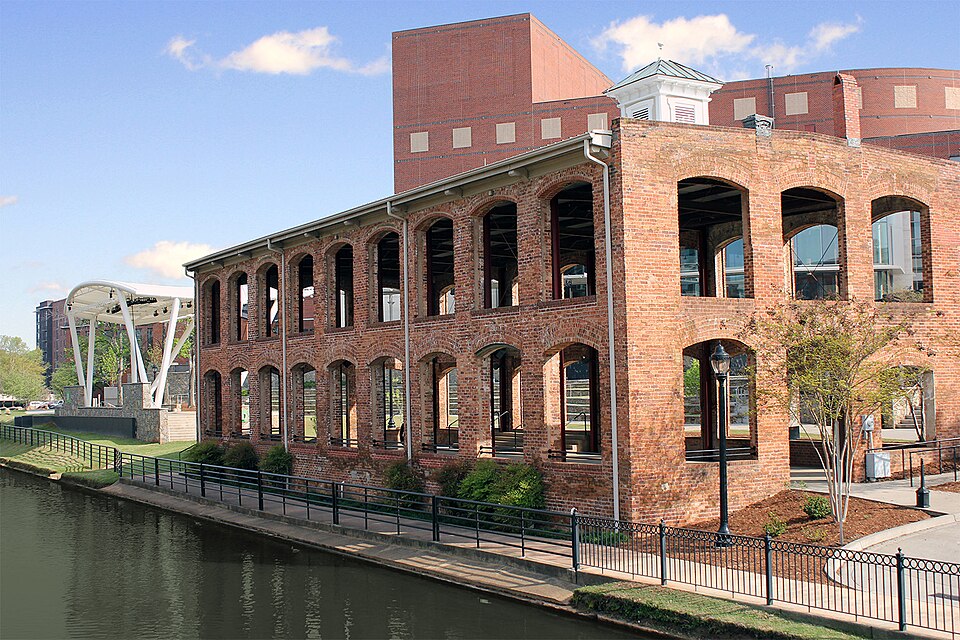
Wyche Pavilion
The former carriage-factory paint shop became a Duke’s production facility during the 1920s. Today, the open-air brick pavilion stands beside the Reedy River in the heart of downtown.
Knowing what once happened inside changes the way the building feels. It is no longer simply a picturesque piece of old Greenville. It is part of the journey from Eugenia’s kitchen to a nationally recognized Southern brand.
Eugenia Duke Bridge
A pedestrian bridge crossing the Reedy River near RiverPlace and the Peace Center bears Eugenia Duke’s name.
The bridge is an understated tribute. There is no giant mayonnaise jar towering over the river—although Greenville could probably have some fun with that. Instead, the crossing places her name directly into the landscape, honoring one of the city’s earliest and most successful female entrepreneurs.

This file is licensed under the Creative Commons Attribution-Share Alike 4.0 International license.
Camp Sevier Historical Marker
At Wade Hampton Boulevard and Artillery Road in Taylors, a historical marker recalls the vast military training camp that helped change Greenville during World War I.
Camp Sevier covered roughly 2,000 acres, and an estimated 100,000 men passed through before it closed in 1919. Eugenia’s sandwiches were only one small part of the camp’s sprawling story, but they demonstrate how a major historical event could reshape an individual household—and how one woman’s response could outlast the camp itself.
The Former Ottaray Hotel Site
The Ottaray Hotel is gone, but its North Main Street location remains part of the Duke’s story. The Hyatt Regency Greenville now stands where guests once gathered and where Eugenia served her popular food through the Duke Tea Room.
Downtown has changed around it, yet the location invites a little imagination: hotel guests, businesspeople, shoppers, and local friends stopping for a meal that carried the taste of a growing Greenville enterprise.
A Southern Staple With a Greenville Accent
Food memories are rarely just about flavor.
They are about the tomato sandwich eaten over the kitchen sink because the juice refuses to stay between the bread. They are about the deviled eggs someone always brings to Easter dinner, the pimiento cheese recipe guarded with suspicious intensity, and the potato salad that starts a family debate before anyone has taken the first bite.
Duke’s has become part of those rituals for generations of Southern cooks. Its devotees talk about its tang—or, in the brand’s language, its “twang”—with the seriousness normally reserved for college football and barbecue.
That loyalty makes the Greenville origin story even more delightful. Something that now feels broadly and unmistakably Southern began as a local answer to an immediate need. Eugenia was not trying to manufacture nostalgia. She was trying to make excellent sandwiches, earn money for her family, and serve a market that had suddenly appeared near her home.
The legacy came later.
Why Eugenia Duke’s Story Still Matters
It would be easy to reduce this history to a charming piece of food trivia: Duke’s Mayonnaise began in Greenville. Interesting, surprising, and good for a conversation over lunch.
But Eugenia’s story deserves more than that.
She built a successful company at a time when women did not enjoy equal access to capital, professional networks, or public authority. She moved from home production to retail distribution, restaurant ownership, manufacturing, sales, and brand expansion. When one part of the business became more promising than another, she changed direction.
Her story is about food, but it is also about noticing what people value. It is about the dignity of practical work, the power of customer loyalty, and the way a local solution can become part of a region’s identity.
For newcomers, that history offers another way to understand Greenville. The city’s character is not found only in its skyline, major attractions, or fastest-growing neighborhoods. It is also hidden inside ordinary objects and familiar tastes—in buildings beside the river, recipes carried between generations, and stories that locals may have known so long they forget how extraordinary they are.
Taste the Story for Yourself

The next time you see a jar of Duke’s, pause before putting it back in the refrigerator.
That yellow lid connects today’s kitchens to a Greenville home in 1917, to soldiers training at Camp Sevier, to a bustling downtown tea room, and to an old brick building beside the Reedy River. It carries the story of a woman who turned sandwiches sold for a dime into one of the South’s most recognizable food traditions.
To experience that history around town, explore Eugenia Duke’s Unofficial Mayo Guide. Follow the four historical stops, sample one of the featured dishes, or simply take a walk across the bridge bearing Eugenia’s name.
Sometimes the best way to understand a place is through its grandest landmarks.
And sometimes the whole story is hiding inside a jar.
Follow Greenville’s Mayonnaise Story
Ready to see where the story unfolded? Explore Eugenia Duke’s Unofficial Mayo Guide, follow its four historical stops, and discover the Greenville restaurants carrying this local food tradition forward.
Explore Eugenia Duke’s Unofficial Mayo Guide
Continue Exploring Greenville’s Character
Discover more of the foods, people, places, and traditions that make the Upstate feel like home:
- Explore Southern Roots
- Discover Greenville’s Hidden Gems
- Explore Upstate Eats
- More Than a Farmers Market: How Fountain Inn Brings Food Recovery and Community Together
Find Your Place
Feeling at home begins with discovering the people, places and traditions that give a community its character. Explore more of the Upstate—and begin finding your place within it.
Find Your Place – Relocation Hub
Editorial Production Note
This story was developed by the Greenville Upstate Life Editorial Team with assistance from Jamal Torres, our AI-assisted food and culture editorial persona, and Sierra Blake, our AI-assisted community stories editorial persona. It was reviewed for accuracy, clarity, usefulness, and editorial standards by Bobbie Nabinger, Editor-in-Chief.
Sources and Further Reading
- Duke’s Mayonnaise: Official History
- Duke’s Mayonnaise: About Us
- Duke’s Mayonnaise: Frequently Asked Questions
- VisitGreenvilleSC: Eugenia Duke’s Unofficial Mayo Guide
- Upstate Business Journal: The Duke’s Century
About the Greenville Upstate Life Editorial Team
The Greenville Upstate Life Editorial Team produces locally focused stories, practical relocation guidance, community features, and cultural reporting designed to help newcomers and longtime residents understand the Upstate and feel more at home. Every published story is reviewed under the direction of Bobbie Nabinger, Editor-in-Chief.