


Just beyond Spartanburg, Lawson’s Fork Creek tumbles over an old mill dam and carries visitors into a landscape where waterfalls, textile ruins, conservation, art and community memory meet.
There are places you visit because someone told you what to see.
Then there are places that begin telling you their story before you know exactly what you are looking at.
At Glendale Shoals Preserve, the first storyteller is the water.
Lawson’s Fork Creek rushes across the old dam, turning a quiet bend near Spartanburg into a broad ribbon of movement and sound. Trees lean toward the banks. Trails slip into the surrounding landscape. Stone and brick remains interrupt the greenery, reminders that this peaceful place once moved to the demanding rhythm of textile production.
It is beautiful—but not polished into something separate from its past.
The old mill is gone. The river remains. The community that grew around both has changed, but it has not disappeared. Today, people arrive to walk, photograph the waterfall, watch birds, sketch, picnic or simply sit where the sound of the water makes the rest of the day feel farther away.
That combination makes Glendale Shoals Preserve one of Spartanburg County’s most revealing outdoor places. It is not only somewhere to get outside. It is somewhere to see how industry, nature, memory and conservation can occupy the same landscape.
A Preserve Built Around Water, Ruins and Memory
Glendale Shoals Preserve protects approximately 29 acres at the former Glendale Mill site along Lawson’s Fork Creek.
The original 12-acre preserve was donated to the Spartanburg Area Conservancy—commonly known as SPACE—in 1993. In 2022, SPACE purchased an additional 17-acre portion of the former mill property to protect the community space from high-density development. The preserve now includes approximately 1.5 miles of nature trails, plant and wildlife habitat, the mill ruins and views of the waterfall cascading over the dam beneath the Glendale Bridge. SPACE
Long before people came here carrying cameras and picnic baskets, the water helped power a textile community.
The area was known as Bivingsville during the 1800s and became home to the Glendale Cotton Mill and the village that grew around it. Families lived, worked, worshipped and built routines around the mill. The surviving structures do not preserve that entire history, but they make it difficult to mistake the land for an ordinary park.
You are not walking through untouched wilderness.
You are walking through a landscape shaped by labor, altered by industry and reclaimed in part by water and vegetation.
That tension gives Glendale much of its character. Nature has softened the hard edges without erasing them. The ruins remain visible enough to invite questions:
Who worked here? What did a normal day sound like? What happened when the mill closed? How did a former industrial property become protected public space?
A short outing can become an encounter with a much longer story.

The Waterfall Draws You In—but the Details Hold You There
The waterfall over the old dam is the preserve’s most immediate attraction.
It is the image people remember and the sound that seems to follow visitors along the nearby paths. Depending on weather and water levels, the creek can appear broad and forceful or expose more of the rocky shoals below.
But Glendale becomes more interesting when you look beyond the main view.
You begin to notice how the bridge frames the landscape. You see plants finding purchase around aging brick and stone. Birds move between river, tree canopy and open ground. Trails offer different perspectives of the creek, while the remnants of the mill make the human history impossible to separate from the natural setting.
The preserve is especially suited to people who enjoy discovery without needing a long or technically demanding expedition. Its approximately 1.5 miles of nature trails can support a relaxed walk, a photography outing or a brief escape from a busy day. SPACE
Still, “short” should not be confused with “risk-free.”
Water near dams, shoals and changing creek conditions can be unpredictable. Rocks may be slippery, submerged hazards may be difficult to see and conditions can change after rain. The preserve states that swimming is at visitors’ own risk and requires shoes. It also prohibits climbing on structures. SPACE
For many visitors, the wisest and most rewarding experience will be to enjoy the water from a safe position, remain on appropriate routes and allow the scenery to provide the adventure.
The Ruins Are Not Playground Equipment
Historic ruins possess a peculiar magnetism.
They invite the imagination to complete missing walls and reconstruct vanished rooms. They turn an outdoor walk into a mystery. At Glendale, the remains of the textile mill help visitors understand that this was once a place of machinery, production and human labor.
But ruins are also unstable remnants of an industrial site.
The preserve’s rules explicitly prohibit climbing on structures. That instruction deserves more attention than a quick glance at a sign. Old masonry can shift. Surfaces may crumble. Openings and drops may not be obvious. A photograph is not worth damaging the site or risking an injury.
Children should remain closely supervised, particularly near:
- The water
- The dam and shoals
- Historic structures
- Uneven surfaces
- Steep or eroded banks
- Trail intersections
- Slippery rocks
The safest way to appreciate Glendale’s history is to leave it undisturbed.
That is also the most respectful way.
These structures are not decorative props placed in the landscape. They are surviving evidence of a community’s industrial and social history. Their value lies partly in their ability to remain for the next person who arrives with questions.
Across the Creek, a Much Larger Outdoor Story Is Growing
Glendale Shoals Preserve is now part of a broader protected landscape.
In June 2025, conservation and government partners celebrated the opening of the adjacent Glendale Nature Park. The 945-acre park contains more than three miles of easy-to-moderate natural-surface hiking trails and provides additional views of Lawson’s Fork Creek. It is the second-largest publicly accessible green space in Spartanburg County. Office of Resilience
The new park is not simply an extension of the original 29-acre preserve under another name. The properties have different histories, sizes, entrances and management structures.
Glendale Nature Park is owned by the South Carolina Department of Parks, Recreation and Tourism and managed by Spartanburg County Parks through a long-term lease. A conservation easement held by SPACE protects it from future development. Its primary trailhead is located at 618 Lewis Chapel Road, and its trail system can also be reached through the adjacent Glendale Shoals area. Office of Resilience
Together with neighboring protected properties, the park contributes to a contiguous conservation corridor of approximately 1,200 acres. That larger landscape supports habitat, water quality, recreation and resilience as Spartanburg County continues to grow. Office of Resilience
This changes the possibilities of a visit.
Someone seeking a brief outing can remain near the shoals, waterfall and historic mill site. A visitor looking for a longer natural-surface hike can investigate the newer park and its trail system.
But those experiences require different preparation.
The preserve near the mill ruins can feel like a scenic community gathering place. The larger nature park asks visitors to be ready for natural-surface trails, changing ground conditions and a more sustained walk.
Knowing which experience you want before arriving will make the day considerably easier.

What Conservation Looks Like When a Community Is Growing
Conservation stories are sometimes told as though saving land means freezing a place in time.
Glendale offers a more complicated and useful picture.
The landscape has already changed many times. Water shaped it. Industry altered it. A textile community grew around it. Buildings disappeared. Vegetation returned. Conservation organizations and public partners then made deliberate choices about what should happen next.
The result is not a return to some untouched past.
It is a commitment to protect what remains while allowing people to experience it responsibly.
That matters in a rapidly growing region. As housing, roads and commercial development expand, public access to rivers, forests and historic landscapes can easily become an afterthought. Glendale shows what becomes possible when conservation is treated as part of community planning rather than as its opponent.
Protected land can:
- Preserve wildlife habitat
- Support water quality
- Give residents access to nature
- Retain community history
- Create educational opportunities
- Offer room for walking and reflection
- Strengthen the identity of a place
- Provide alternatives to commercial entertainment
For someone deciding whether Spartanburg County might feel like home, places like Glendale reveal values that are difficult to capture in a housing statistic.
They show what a community has decided is worth keeping.
A Place for Artists, Naturalists and Quiet Observers
Not everyone experiences a landscape by moving quickly through it.
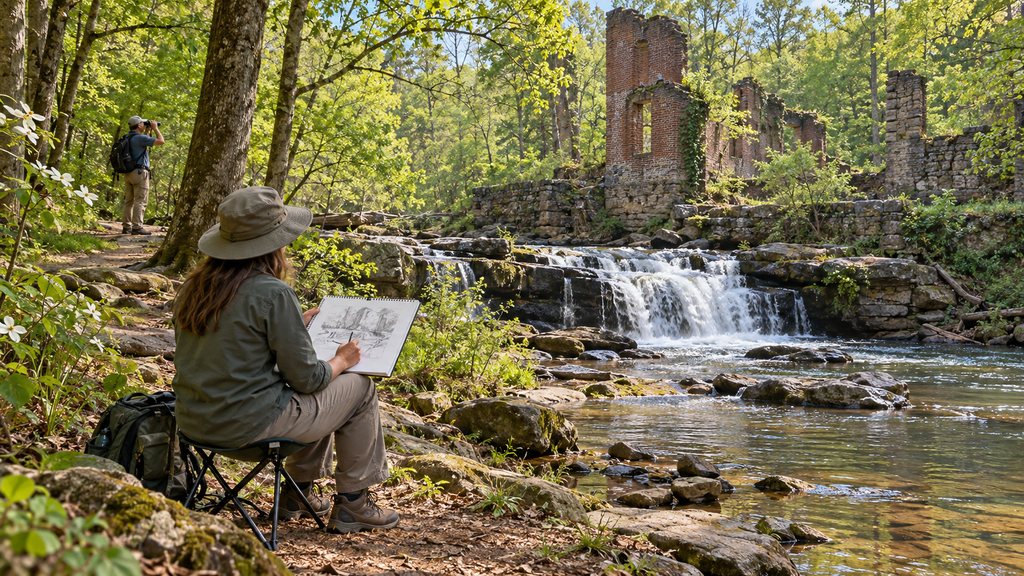
Some people arrive at Glendale to paint. Others bring cameras, binoculars or sketchbooks. Some find a place near the water and stay there.
The preserve’s mix of moving water, industrial remains, open space and vegetation gives artists an unusual range of material. A single view can hold rough masonry, reflective water, tangled roots and the clean geometry of a bridge.
Photographers should remember that protecting the place matters more than getting the perfect angle. Remain within safe public areas, avoid climbing ruins, respect other visitors and do not disturb plants or wildlife to improve a composition.
Naturalists may find another layer entirely. SPACE notes that the preserve supports significant plant, animal and bird life. The creek and surrounding habitat create an environment where careful observation is rewarded. SPACE
You do not have to identify every species to enjoy the experience.
Sometimes noticing is enough: a change in birdsong, a flash of movement near the water, the difference between sunlight in an open field and beneath the trees.
Glendale makes room for curiosity without demanding expertise.
How to Choose Your Glendale Experience
Because Glendale Shoals Preserve and Glendale Nature Park are connected but distinct, begin by deciding what kind of outing fits your day.
Choose Glendale Shoals Preserve if you want:
- The waterfall and old mill dam
- Historic industrial ruins
- A shorter nature walk
- Photography or sketching
- A picnic or unhurried scenic stop
- A first introduction to the Glendale community
- A place where nature and history are immediately visible together
Choose Glendale Nature Park if you want:
- A longer natural-surface hike
- A larger protected landscape
- More than three miles of trails
- Forest and creek views
- A trailhead designed for the newer park
- A deeper outdoor experience close to Spartanburg
Consider experiencing both if:
- You have sufficient time
- Weather and trail conditions are favorable
- Everyone in your group is prepared for unpaved terrain
- You have reviewed current access information
- You understand that the properties have different entrances and trail conditions
Do not rely solely on a map pin labeled “Glendale.” Confirm whether you are navigating to the historic shoals area or the newer nature park trailhead.
What to Know Before You Go
Glendale Shoals Preserve is open from sunrise to sunset.
The preserve prohibits motorized vehicles, hunting, camping, campfires, firearms, paintball, loud music, removal of plants and unauthorized large gatherings. Dogs must remain under their owner’s control on a leash, and owners must remove pet waste. Visitors must not climb on historic structures. SPACE
Practical preparation
- Check the weather and recent rainfall.
- Expect natural and potentially uneven surfaces.
- Wear supportive shoes with good traction.
- Bring drinking water.
- Keep children close near the creek and ruins.
- Keep dogs leashed.
- Carry out anything you bring in.
- Do not climb or enter unstable structures.
- Photograph plants without picking them.
- Confirm current parking and access information.
- Use extra caution around wet rocks and moving water.
- Leave before sunset unless official information states otherwise.
Accessibility considerations
Do not assume the preserve’s natural trails, rocky areas or historic site are fully accessible. Visitors with mobility concerns should contact SPACE or Spartanburg County Parks before traveling.
The newer Glendale Nature Park has natural-surface trails described as easy to moderate, but that description does not necessarily indicate wheelchair or stroller accessibility. Ground conditions can also change after rain.
Accessibility should be verified for the specific entrance and route—not inferred from a general park description.
Glendale Is Not Quite a Park and Not Quite a Museum
A museum tells you where to stand and often explains what you are seeing.
A traditional park may provide a playground, field or paved loop with an obvious purpose.
Glendale is less contained.
It asks visitors to hold several stories at once: beauty and industry, public recreation and preservation, loss and renewal. The waterfall can be enjoyed without knowing the history, but the history makes the water feel different. The ruins can be admired as textures and shapes, but their relationship to the former mill community gives them weight.
That layered experience is why Glendale belongs in Out and About.
It is a place you can visit today, but it also changes how you understand where you are.
For newcomers, the preserve opens a window into a part of Spartanburg that may not appear in a conventional relocation search. For longtime residents, it offers a chance to return to a familiar landscape and notice something previously overlooked.
And for the broader community, it demonstrates that an old industrial site does not have to be erased or overdeveloped to become useful again.
Sometimes the most meaningful next chapter begins by protecting the pages that remain.

Let the River Introduce You to Glendale
Begin with the waterfall.
Listen before you start walking. Notice where the old structures meet the vegetation and how the river continues through both. Take the shorter outing if that is what the day allows, or prepare for a longer exploration through the adjacent nature park.
You do not have to see everything for Glendale to leave an impression.
This is a place where the Upstate’s industrial past and environmental future are not separated by a museum wall. They are standing beside the same creek, asking the community to remember one and protect the other.
Review current information for Glendale Shoals Preserve
Finding Your Place
Feeling at home begins with discovering the people, places and traditions that give a community its character. Explore more of the Upstate—and begin finding your place within it.
Editorial Production Note
This story was written and produced by the Greenville Upstate Life Media editorial team with assistance from Calvin Lee, our AI-assisted outdoor culture and hidden-places editorial persona, and Sierra Blake, our AI-assisted local-news and human-interest editorial persona. Calvin contributed the visually descriptive outdoor perspective, visitor experience and careful attention to the preserve’s natural and historic landscape. Sierra helped shape the community-memory narrative, connecting the former mill village, conservation efforts and the people whose stories remain part of Glendale. The article was reviewed and edited by Bobbie Nabinger, Editor-in-Chief.
AI Image Disclosure
Unless otherwise identified or credited, the images accompanying this article are AI-assisted editorial illustrations created for Greenville Upstate Life Media to represent the setting, atmosphere and themes of the featured story. They are not documentary photographs of the actual people, businesses, organizations, locations, events or activities described.
Sources and Further Reading
- Glendale Shoals Preserve — Spartanburg Area Conservancy
- Glendale Nature Park — Spartanburg County Parks
- Glendale Nature Park Grand Opening — South Carolina Office of Resilience
- Spartanburg Trail Segments — PAL Spartanburg
- Parks and Preserves — Experience Spartanburg