


The dining table may be too large for the room you want next, but it still holds decades of birthdays, holiday dinners, and hurried weekday breakfasts.
The upstairs bedrooms may sit empty most of the year, yet one of them is where your grandchildren sleep when they visit. The yard may take more energy than it once did, but it is also where you drink your morning coffee, grow tomatoes and watch the seasons change.
This is why downsizing is rarely just a mathematical exercise.
It is tempting to reduce the decision to square footage, bedroom counts and maintenance costs. But people are not simply deciding how much house they want to keep. They are deciding which parts of their lives should become easier—and which parts must come with them.
For adults considering a move to Greenville or a different home within the Greenville area, the choices can be especially appealing. Downtown condominiums, suburban townhomes, smaller detached houses, apartments and communities beyond the city offer different combinations of convenience, privacy, activity, and responsibility.
The best choice is not automatically the smallest home. It is the home that gives the life you value enough room to continue while releasing the work, expense, and worry you no longer want to carry.
Downsizing Is Really About Right-Sizing Your Life
The word “downsizing” can sound like a gradual surrender.
Less space. Fewer belongings. A smaller yard. Fewer rooms for family. A quieter version of the life you once had.
But that is only one way to interpret it.
A thoughtful move after 55 can exchange unused square footage for freedom. It can replace a demanding property with a home that is easier to leave when you travel. It can bring restaurants, parks, healthcare, family or community activities closer. It can turn weekends once consumed by yardwork and repairs into time available for people and experiences.
That is not shrinking. It is reallocating.
The goal is not to fit your present life into the smallest possible container. It is to choose a home that supports the life you want now while remaining realistic about the years ahead.
Start With What You Want the Move to Change
Before searching listings, finish these three sentences:
- I want to keep…
- I want to make easier…
- I am ready to release…
Your answers may look something like this:
| Keep | Make easier | Release |
|---|---|---|
| Family gatherings | Leaving town for extended travel | Constant yardwork |
| A garden or outdoor space | Reaching doctors and groceries | Unused formal rooms |
| Privacy | Cleaning and maintenance | A long staircase |
| A home office | Meeting people and staying active | Expensive repairs |
| Space for a pet | Locking and leaving the property | Excess storage |
| A familiar community | Living on one level | Driving everywhere |
This exercise prevents a common mistake: choosing a smaller home that removes the very things that made home meaningful.
A townhome with no usable outdoor space may technically be lower maintenance, but it may not work for someone who begins every morning in a garden. A downtown condominium may offer restaurants and cultural activity nearby, but it may feel confining to someone who values privacy and quiet. A smaller detached home may preserve independence while still leaving its owner responsible for a roof, yard and exterior repairs.
The correct answer depends on what you are trying to preserve—not merely what you are trying to eliminate.

Smaller Does Not Always Mean Easier
A smaller home may require less cleaning, heating and furnishing. That does not automatically make it more manageable.
A compact house can still have:
- Steep entry steps
- Bedrooms on a second floor
- Narrow interior doorways
- A difficult driveway
- A slippery or uneven walkway
- A bathtub that is hard to enter
- Laundry located in a basement
- Limited parking for visitors
- An unexpectedly demanding yard
- Older plumbing, roofing or electrical systems
- Little room for a future caregiver or visiting family member
Meanwhile, a slightly larger one-story home with a simple layout may function more comfortably for many years.
AARP’s HomeFit resources emphasize that most homes were designed for young, able-bodied adults and encourage people to evaluate how well a house can serve different ages and abilities. The organization’s recommendations include examining entrances, bathrooms, lighting, flooring, controls and other everyday features that affect comfort and safety. aarp.org
The question is not simply, “How many square feet does this house have?”
Ask:
How much of this home can I use comfortably, and how much of it will require work from me?
Look for Flexibility Before You Need It
Planning for future comfort does not mean designing your life around limitations you do not have.
It means choosing features that are useful now and protective later.
Consider:
- A step-free or low-step entrance
- A bedroom and full bathroom on the main level
- Laundry on the same level as the primary bedroom
- Good natural and artificial lighting
- Lever-style door handles
- A shower that can be entered easily
- Space around bathroom fixtures
- Nonslip surfaces
- Manageable thresholds
- Hallways and doors with comfortable clearance
- Convenient parking
- Room for visitors or short-term support
- A layout that does not depend on stairs
- Space that could change purposes over time
A guest room could eventually become a hobby room, caregiver space, or office. A first-floor den could become a bedroom if needed. A wider hallway does not announce itself as an accessibility feature; it simply makes the house easier to navigate while carrying laundry, luggage, or furniture.
Good design often feels less like preparation for aging and more like a home that is pleasantly easy to use.

Greenville Offers More Than One Version of Convenience
“Greenville-area living” can mean very different things depending on the exact address.
Someone may choose a condominium or apartment near downtown activity. Another person may prefer an established neighborhood with a smaller detached home. Someone else may look toward Travelers Rest, Greer, Mauldin, Simpsonville, Fountain Inn, or another surrounding community for a different combination of pace, housing, and access.
Each setting asks for different tradeoffs.
Closer to Downtown
Potential advantages may include:
- Proximity to restaurants, events, and cultural activities
- Reduced yard responsibility
- Easier access to social opportunities
- More compact daily routines
- The possibility of walking to selected destinations
Questions to investigate:
- Can you reach the places you need without a car—or only the places you enjoy?
- Is parking included and convenient?
- Are elevators reliable and accessible?
- How are groceries and packages brought into the unit?
- What are the rules for guests and pets?
- How much noise comes from nearby activity?
- What happens during festivals, road closures or large events?
- Is exterior maintenance truly included?
Suburban Communities
Potential advantages may include:
- A wider range of home types
- Garages and additional storage
- Familiar shopping and medical corridors
- Neighborhood amenities
- Easier accommodation for visiting family
Questions to investigate:
- How much driving will daily life require?
- Does traffic change significantly during commuting hours?
- Who maintains the exterior, roof, and landscaping?
- Are amenities genuinely useful to you?
- Will the floor plan remain workable?
- How close are your most frequently used services?

Smaller Communities and Outlying Areas
Potential advantages may include:
- More space and privacy
- A quieter setting
- A traditional neighborhood or small-town atmosphere
- Potential access to trails, lakes, or rural landscapes
- Separation from the busiest commercial corridors
Questions to investigate:
- How far away are healthcare, groceries, and pharmacies?
- Is the property served by public water and sewer?
- Is internet service sufficient at the exact address?
- Who provides trash collection?
- How much property maintenance is required?
- Would the location remain manageable if driving became more difficult?
There is no universal winner. The right setting depends on the ordinary week you expect to live.
Healthcare Access Is More Than Distance to a Hospital
People sometimes evaluate healthcare access by locating the nearest hospital on a map.
That is a useful beginning, but everyday access involves more.
Consider the complete network you may need:
- Primary-care provider
- Specialists
- Pharmacy
- Urgent care
- Laboratory and imaging services
- Physical or occupational therapy
- Dental and vision care
- Mental-health support
- Rehabilitation
- In-home services
- Family or caregiver access
- Transportation to appointments
A home may be relatively close to a major medical campus yet inconvenient for the appointments you attend most frequently. Conversely, a community outside central Greenville may place routine services, a pharmacy, and primary care within a comfortable drive.
Before choosing a location, test the route to the providers or facilities that matter to you. Travel it during the time of day when appointments would realistically occur. Check parking, walking distance, and building access—not only mileage.
The Appalachian Council of Governments serves as the Area Agency on Aging for Greenville and five neighboring Upstate counties. Its programs provide information and assistance for older adults, people with disabilities, and caregivers, including caregiver support and long-term-care advocacy resources. Senior Advocacy
Those resources can help families understand available support, but eligibility and service availability should always be confirmed for the individual and address.
Transportation Should Be Evaluated Before It Becomes Urgent
A community may feel convenient while you are comfortable driving everywhere. Its suitability can change if you eventually prefer to drive less, avoid nighttime travel, or need help reaching appointments.
Ask:
- Can daily necessities be reached without using an interstate?
- Are family members close enough to help realistically?
- Do ride services operate reliably at the address?
- Is public transit nearby and useful for the destinations you need?
- Are sidewalks continuous and comfortable?
- Can you walk safely from the home to anything meaningful?
- Does the community provide private transportation?
- Are medical transportation services available?
- Would groceries and prescriptions be easy to have delivered?
Greenlink provides fixed-route public transit within its service structure, and the City of Greenville’s Greenville Area Paratransit program serves people certified under Americans with Disabilities Act eligibility requirements who cannot use fixed-route service because of a disability. Availability should be evaluated against the exact residence and destinations because being “near Greenville” does not guarantee useful transit access. Greenville, SC – Official Website
Transportation planning is not about assuming that driving will disappear. It is about preserving options.
Understand What “Maintenance-Free” Really Includes
Few phrases in real estate marketing sound more appealing than “maintenance-free living.”
The phrase should always be followed by a question:
Which maintenance, performed by whom, and paid for how?
In a condominium or townhome community, an association may handle some combination of:
- Exterior surfaces
- Roofing
- Common landscaping
- Community roads
- Amenities
- Insurance on shared structures
- Pest services
- Trash collection
- Exterior lighting
- Stormwater facilities
But responsibilities vary. The owner may still be responsible for windows, doors, plumbing lines, HVAC equipment, patios, balconies, interior damage, or portions of the exterior.
Before buying, review:
- Covenants and restrictions
- Bylaws
- Rules and regulations
- Current budget
- Reserve information
- Insurance responsibilities
- Recent meeting minutes
- Pending litigation
- Recent or anticipated assessments
- Maintenance boundaries
- Rental and pet restrictions
- Architectural rules
- Age restrictions, if advertised
- Parking and guest policies
South Carolina’s Department of Consumer Affairs maintains HOA education resources and publishes information about homeowners-association complaints and applicable state laws. These resources provide helpful background, but community-specific documents still require careful review. Consumer Affairs
An association fee is not inherently good or bad. It should be evaluated against the services provided, the association’s financial condition, and the responsibilities it removes from—or leaves with—the homeowner.
Plan for Guests, Family and the Life You Still Want to Host
Downsizing conversations often focus on rooms that are not used every day.
But infrequent use does not always mean unimportant use.
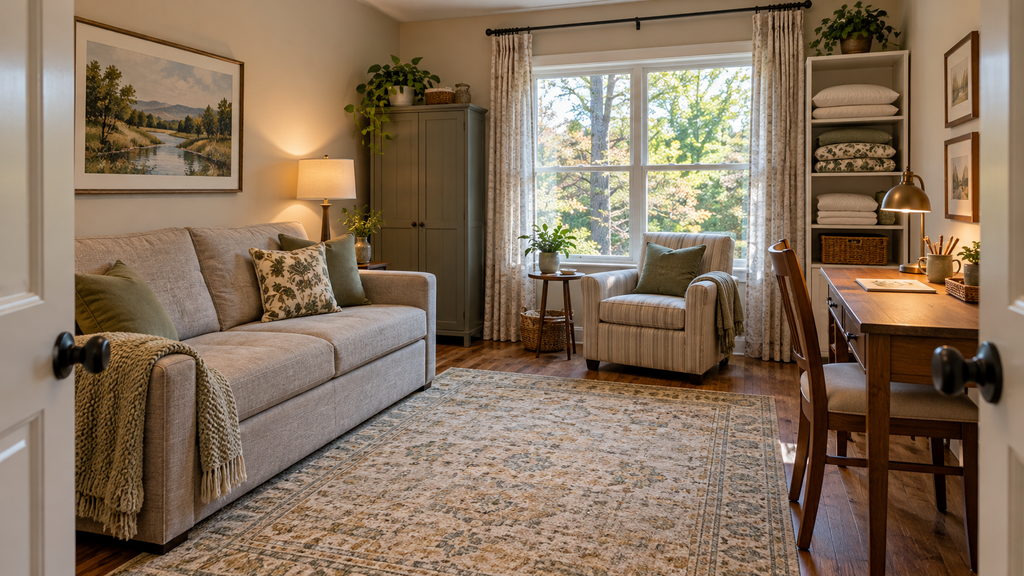
A guest room may allow adult children to visit. A dining area may gather family during holidays. A hobby room may support the work that gives structure and joy to retirement. A home office may remain important long after full-time employment ends.
Instead of counting how often a room was used last year, ask what role it plays in the life you want next.
Creative alternatives may include:
- A flexible office and guest room
- A sleeper sofa in a den
- A community guest suite
- Nearby lodging for larger family visits
- An expandable dining table
- Shared community gathering space
- Climate-controlled storage outside the home
- A garage designed for both parking and hobbies
The goal is not to preserve every room exactly as it exists today. It is to preserve the function and feeling that mattered.
Do Not Let Belongings Make the Housing Decision
A household can accumulate decades of objects before anyone notices how many decisions they represent.
Some belongings are deeply meaningful. Others remain because no one has had time to decide what to do with them.
If every possession becomes nonnegotiable, the next house may be selected primarily as a storage solution.
Begin slowly and by category:
- Keep items that are useful or genuinely meaningful.
- Give important items to family members who want them.
- Sell, donate, or responsibly dispose of what no longer serves your life.
- Digitize appropriate photographs and documents.
- Measure furniture before assuming it will fit.
- Avoid paying indefinitely to store items you do not intend to use.
- Allow emotional decisions more time than ordinary household sorting.
Do not begin with the most emotionally charged boxes. Start with duplicates, expired items, unused equipment, or rooms that already feel less personal.
Progress builds confidence.
Compare the Full Monthly Cost—not Just the Purchase Price
A smaller or lower-priced home is not necessarily less expensive to live in.
Estimate:
- Mortgage or rent
- Property taxes
- Homeowners or condominium insurance
- HOA or condominium fees
- Utilities
- Landscaping
- Exterior maintenance
- Interior repairs
- Transportation
- Parking
- Storage
- Amenity fees
- Future accessibility improvements
- Travel required for healthcare and daily needs
A condominium fee may appear high until compared with the cost of roofing, lawn care, exterior insurance and amenities. Conversely, an association payment may provide little value if it does not cover the work you hoped to eliminate.
The financial question is not simply, “Can I buy this home?”
It is:
Will the complete cost of living here support the freedom I expect the move to create?
A qualified financial, tax, insurance, or legal professional should evaluate questions specific to your situation.
Try the Life Before You Buy the Address
Before purchasing, spend time living the routine the property would require.
Visit on a weekday and a weekend. Drive to groceries, healthcare, and the places you expect to enjoy. Notice the terrain between the parking area and the front door. Carry something through the entrance. Listen for traffic and nearby activity.
If the home is in a managed community, talk with residents when appropriate. Ask what they enjoy and what surprised them. Verify every important claim with the association, governing documents, or relevant provider.
If you are relocating from outside the Upstate and remain uncertain, a rent-first period may give you time to compare communities without forcing a permanent decision.
Related reading:
- Rent First, Learn the City: When a One-Year Lease Can Be a Smart Upstate Relocation Strategy
- The Utility Map Is Not the City Map
- A Greenville Mailing Address Doesn’t Always Mean Greenville City

A Better Downsizing Question
Instead of asking, “How little space can I live with?” ask:
- What do I want more time for?
- Which responsibilities am I ready to release?
- What helps me feel connected?
- Who do I want to welcome into my home?
- What activities need room?
- Which errands should become easier?
- What features could protect my independence?
- What monthly costs feel comfortable?
- Would this home still work if an ordinary task became harder?
- Does this community give my life room to grow?
The answers may lead to a smaller home. They may also lead to a different type of home, a more convenient location or a layout that simply works better.
That is the real purpose of right-sizing.
You are not measuring how much of your old life can be discarded. You are deciding what the next chapter deserves to hold.
Your Next Step: Create a Keep, Change, and Release List
Before opening another real estate search, make three lists:
Keep
The relationships, routines, belongings, spaces, and experiences your next home should continue supporting.
Change
The parts of your current home or location that should become easier, safer, closer, or more manageable.
Release
The maintenance, unused space, financial pressure, or obligations you no longer want your home to require.
Bring these lists to every property visit. They will help you evaluate more than bedrooms, finishes, and square footage. They will help you recognize whether a home supports the life you are actually planning.
Finding Your Place
The right move begins with the right questions. Explore the communities, practical guidance and local research that can help you choose with greater confidence.
Editorial Production Note
This story was developed by the Greenville Upstate Life Media Editorial Team with assistance from Lila Green, our AI-assisted aging, housing and wellness editorial persona, and Georgia Wren, our AI-assisted relocation and community-integration editorial persona. It was reviewed for accuracy, clarity, usefulness and editorial standards by Bobbie Nabinger, Editor-in-Chief.
AI Image Disclosure
Unless otherwise identified or credited, the images accompanying this article are AI-assisted editorial illustrations created for Greenville Upstate Life Media to represent the setting, atmosphere and themes of the featured story. They are not documentary photographs of the actual people, businesses, organizations, locations, events or activities described.
Sources and Further Reading
- Appalachian Council of Governments: Aging Services
- Appalachian Council of Governments: Information and Referral
- Appalachian Council of Governments: Family Caregiver Program
- AARP HomeFit Guide
- AARP HomeFit Guide Download
- City of Greenville: Greenlink Transit
- City of Greenville: Greenville Area Paratransit
- South Carolina Department of Consumer Affairs: HOA Information
- South Carolina Department of Consumer Affairs: HOA Laws
This article provides general relocation and housing information. It is not medical, legal, financial, tax or real-estate advice. Readers should confirm property-specific information and consult appropriately qualified professionals.