

Belonging often begins with a familiar place, a recognized face, and a reason to return. In this series, Greenville Upstate Life Media explores the markets, libraries, cafés, parks, and community traditions where repeated visits help newcomers become part of local life.
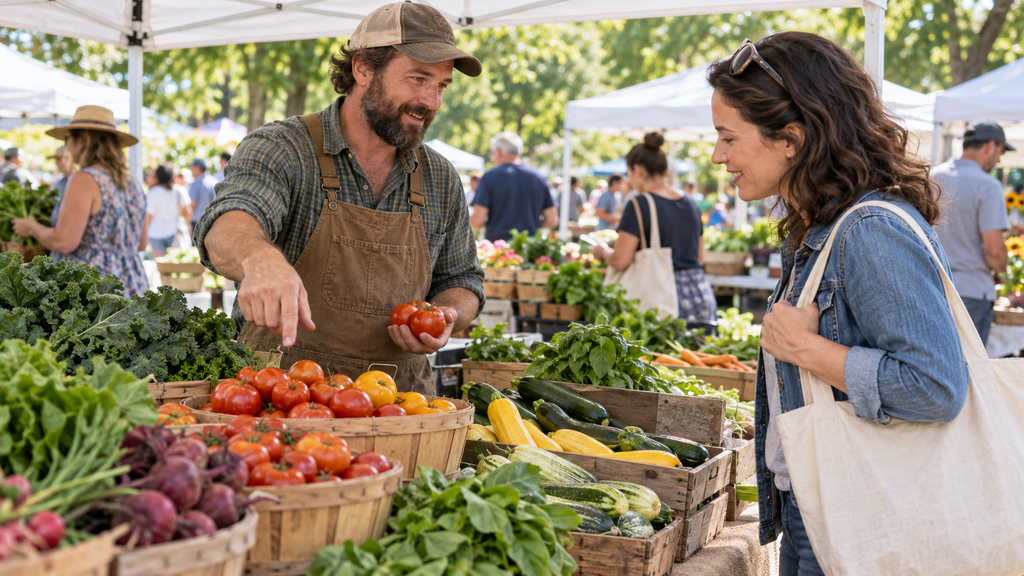
On a Saturday morning at Northside Harvest Park, shopping can begin with something wonderfully imperfect.
The strawberries may disappear earlier than expected. The person ahead of you may know exactly which loaf to buy. A farmer might explain why this week’s tomatoes taste different from the ones available last month. Somewhere between the breakfast aromas, folded market tents and bags filling with vegetables, you begin to realize that buying local food requires a slightly different rhythm.
You return the following week knowing which table to visit first.
Soon, someone recognizes you.
That small moment—the nod, the remembered order, the conversation resumed from Saturday before—is part of what makes a farmers market more than an alternative grocery aisle. It becomes one of the places where a newcomer can learn the seasons, meet the people behind the food and slowly become a regular.
In Spartanburg, that experience does not end when the market closes at noon. Hub City Farmers Market and the PAL Food Hub create two connected ways to buy from regional producers: one social and immediate, the other organized around online ordering, scheduled pickup and home delivery.
Together, they help answer a practical question:
How can buying local become part of an ordinary week rather than something you intend to do someday?
Two Ways into Spartanburg’s Local-Food Community
Hub City Farmers Market is the visible, Saturday-morning side of the system.
From April through November, the producer-only market operates Saturdays from 8 a.m. to noon at Northside Harvest Park, 498 Howard Street in Spartanburg. Its current offerings may include seasonal fruits and vegetables, eggs, meats, dairy products, honey, coffee, baked goods, pantry items, handmade goods, breakfast selections, live music, and family activities. Vendor participation and products change with the season and from one week to the next. PAL Spartanburg
The PAL Food Hub offers a different kind of access.
Instead of walking from tent to tent, shoppers create an account through the online storefront, select products supplied by participating farms and food producers, choose a pickup or eligible delivery option, and complete their purchase within the ordering window. Current selections can include produce, meat, dairy, eggs, grains, breads, baked goods and specialty products, with availability changing according to season and supply. Spartanburg Food Hub
The market and food hub are not identical experiences, and that is precisely their strength.
At the market, you can ask questions, discover something unexpected, and meet the person who grew or made what you are buying. Through the Food Hub, several producers can become part of one organized order that fits more easily into a working week.
One creates connection through presence.
The other creates connection through convenience.
Both help shorten the distance between a Spartanburg household and the farms producing its food.
Why “Producer-Only” Matters
The phrase producer-only market can sound like industry language, but its meaning is refreshingly straightforward: vendors are expected to sell what they have grown, raised, baked, prepared, or made rather than simply reselling products acquired elsewhere.
That changes the conversation.
When you ask about a vegetable, the person answering may know when it was harvested, how the weather affected it, or how customers usually prepare it. If you return for bread, mushrooms, honey or eggs, you are not only remembering a product. You are beginning to recognize its producer.
PAL’s current materials describe the Hub City Farmers Market as bringing together local farms, culinary creators, small-batch artisans and neighbors. The organization also posts recent vendor lists, giving shoppers a way to check who may be attending before leaving home. PAL Spartanburg
That transparency is useful for anyone, but especially for newcomers who do not yet know the names of area farms or understand the Upstate growing calendar.
The first trip may involve more questions than purchases:
- What is in season right now?
- Does this vendor return every week?
- How should I store this?
- What is the easiest way to prepare it?
- Can I order from this producer outside the market?
- Do you accept cards, cash, or market-program benefits?
- When will this crop return?
Those questions are not evidence that you do not belong. They are how familiarity begins.
A Food Hub Turns Many Farms into One Practical Order
Farmers markets are lively, tactile, and personal—but not every household can reliably shop on Saturday morning.
Work schedules change. Children have activities. Weather interferes. Some people find crowds tiring or have transportation and mobility considerations. Others want to plan meals before they shop rather than make decisions while standing in front of a table.
The PAL Food Hub helps bridge that gap.
PAL currently describes its online store as working primarily with farmers within approximately 75 miles of Spartanburg County, occasionally sourcing from as far as 150 miles away during colder months. Shoppers can combine products from participating producers into one cart rather than coordinating separate purchases with multiple farms. Spartanburg Food Hub
Under the currently published schedule:
- Shoppers create a free online account.
- Fresh products are updated for ordering.
- Customers fill their carts with available local items.
- Orders must currently be completed by Monday at 2 p.m.
- Pickup or eligible delivery occurs the following Thursday.
The PAL office at 226 South Spring Street is one current pickup location, with additional published pickup options elsewhere in Spartanburg. Delivery availability depends on distance and order requirements. Because ordering windows, pickup sites, delivery thresholds, and product availability may change, shoppers should confirm the current instructions in the online store before placing an order. Spartanburg Food Hub
This is the part of the local-food system most people never see.
A farmer may grow beautiful food, but growing is only part of the work. Products must also be organized, marketed, sold, transported, and delivered while they are still fresh. A small or mid-sized farm may not have the time or infrastructure to reach individual households, restaurants, stores, and institutions independently.
A food hub creates a central channel through which many buyers can reach many producers.
PAL says the Food Hub serves individual shoppers as well as restaurants, retailers, and other wholesale buyers. The organization describes the hub as a way for farmers to spend less time individually selling their products and more time producing them. Spartanburg Food Hub
That is what lies behind the pickup bag: not just food, but coordination.

Where Convenience and Community Meet
Convenience sometimes sounds like the opposite of community. One suggests efficiency; the other suggests time, conversation, and presence.
Here, they support each other.
An online order can become a first step for someone who feels uncertain at a farmers market. A market conversation can introduce a shopper to a farm whose products they later order through the Food Hub. A restaurant can discover a producer through a centralized weekly list. A customer picking up groceries may learn about the Saturday market, an upcoming program, or another local business.
The system offers more than one way to enter.
That matters because no single definition of participation works for everyone. Some residents want to linger at the market with coffee and music. Others want to collect a carefully planned order on Thursday and get home. Many will do both at different times.
The goal is not to prove that one method of shopping is morally superior. It is to make local food easier to encounter, understand, and incorporate into real life.
A Market Can Teach You the Calendar of a Place
Most grocery stores are designed to minimize seasonal disruption. Familiar products appear throughout the year, even when they have traveled long distances to reach the shelf.
A producer market tells time differently.
The tables change as the growing season changes. A product arrives, flourishes, and eventually disappears. Weather leaves evidence. Abundance comes in waves. Shoppers learn that anticipation is part of the pleasure.
For someone new to the Upstate, this can be a delicious kind of orientation.
You begin learning when local strawberries appear, how long summer tomatoes remain abundant, and which greens return as temperatures cool. You discover unfamiliar varieties. You hear how rain, heat, or an early cold snap affected what producers could bring.
This knowledge is not acquired from one perfect shopping trip. It accumulates through repetition.
That is where the market begins to create something larger than a transaction. The shopper stops asking only, “What can I buy today?” and begins understanding, “What is happening here right now?”
Food Access Is Part of the Story
A meaningful local-food system cannot be measured only by how attractive the market looks on a Saturday morning. Access matters too.
Hub City Farmers Market currently accepts SNAP/EBT and operates a Double SNAP program. PAL states that eligible shoppers can presently double up to $40 in SNAP spending at the Saturday market and receive an additional amount specifically for fruits and vegetables. The organization reports that $51,118 was spent with local farmers and vendors through the market’s Double SNAP program in 2025. PAL Spartanburg
Program terms, matching amounts, and eligibility procedures can change, so readers should verify current details directly with PAL before planning purchases around a particular benefit.
PAL also says Food Hub purchases help support the donation of local produce to community members who might otherwise have limited access to fresh food. Its food-hub expansion plans include selling to restaurants, stores, schools, and hospitals while increasing opportunities for small, beginning, underserved, and veteran producers. PAL
This places the market and Food Hub inside a much larger story.
Buying locally is not only about the distance a tomato traveled. It is also about whether farmers have viable ways to sell, whether households can realistically participate, and whether fresh food reaches people through more than one channel.

How Newcomers Become Regulars
The social science behind becoming a regular is quieter than friendship but more meaningful than anonymity.
Researchers use the term familiar strangers for people we repeatedly recognize in shared public places without truly knowing. A familiar stranger may be the person who always arrives before you, the vendor whose face you remember, or the shopper carrying the same basket each Saturday.
At first, there may be no conversation.
Then there is a nod.
A week later, someone mentions the weather. Eventually, a producer remembers what you bought or asks how you prepared it. You may never become close friends, but the place has changed. It now contains people who recognize you—and people you recognize in return.
This is one way a new community becomes emotionally legible.
A farmers market is particularly good at creating these low-pressure connections because conversation has an easy starting point. You do not need a clever introduction. You can ask about peaches, bread, mushrooms, or what to cook for dinner.
The exchange may last thirty seconds, but the next visit begins with thirty seconds of shared history.
That is why Hub City Farmers Market is the right place to begin Greenville Upstate Life Media’s Where Newcomers Become Regulars series. The market offers more than access to local food. It gives people a recurring reason to show up.
And showing up is often how belonging starts.
Your First Visit Can Be Simple
You do not need to transform your household’s entire food budget or arrive with extensive knowledge about farming.
Begin with one Saturday.
Hub City Farmers Market
Current regular-season location:
Northside Harvest Park
498 Howard Street
Spartanburg, South Carolina
Current regular-season schedule:
Saturdays, 8 a.m.–noon
April through November
PAL also currently presents a Second Sunday market on Morgan Square from May through October. Confirm the specific date and location before attending because special markets and seasonal schedules can change. PAL Spartanburg
A comfortable first-market plan
- Review the current vendor list before leaving home.
- Bring a reusable bag.
- Carry more than one payment option when possible because vendor practices may differ.
- Walk through once before deciding what to buy.
- Ask what is especially good that week.
- Purchase one familiar item and one thing that interests you.
- Note the name of the farm or maker.
- Return another week and look for that same table.
The point is not to “complete” the market. It is to establish a reason to come back.
When Saturday Does Not Work, Try the Food Hub
If a weekend market does not fit your life, begin online.
Visit the PAL Food Hub, review the current ordering process, and browse what is available. You can create an account, select eligible pickup or delivery, and build an order from multiple participating producers.
A practical first order might include products your household already uses—eggs, bread, meat, vegetables, or pantry goods. Starting with familiar foods makes it easier to evaluate how the ordering and pickup process fits your week.
Then, if you enjoy something, find out who produced it.
That single question turns a grocery item back into a relationship.

More Than a Shopping Decision
Local food is sometimes presented as a grand lifestyle identity. You are either the kind of person who knows every farmer by name, or you are not.
Real life is more forgiving.
You can begin with one tomato, one loaf of bread, or one Thursday pickup. You can shop locally when the season, schedule, and budget allow. You can ask questions without pretending to know the answers. You can appreciate convenience and still care where food comes from.
The value lies in drawing the circle a little closer.
A Saturday market makes the people behind the food visible. A food hub makes their products easier to reach during the rest of the week. Together, they create a system in which local purchasing can become less of a special occasion and more of an ordinary habit.
Then something else happens.
The market route becomes familiar. The seasonal changes begin to make sense. A face behind a table brightens with recognition.
You came looking for food.
You found one of your places.
Start Your Own Local-Food Routine
Explore the current Hub City Farmers Market schedule, check the latest vendor information or visit the PAL Food Hub to see how online ordering works.
Choose the option that fits your life now. You can always open another door later.
Finding Your Place
Feeling at home begins with discovering the people, places, and traditions that give a community its character. Explore more of the Upstate—and begin finding your place within it.
Editorial Production Note
This inaugural story in Greenville Upstate Life Media’s Where Newcomers Become Regulars series was developed by the Greenville Upstate Life Media Editorial Team with assistance from Lila Green, our AI-assisted food, wellness, and local-agriculture editorial persona, and Amanda Rivers, our AI-assisted family-life, accessible-experiences, and community-resource editorial persona. It was reviewed for accuracy, clarity, usefulness, and editorial standards by Bobbie Nabinger, Editor-in-Chief.
AI Image Disclosure
Unless otherwise identified or credited, the images accompanying this article are AI-assisted editorial illustrations created for Greenville Upstate Life Media to represent the setting, atmosphere and themes of the featured story. They are not documentary photographs of the actual people, businesses, organizations, locations, events or activities described.
Sources and Further Reading
- Hub City Farmers Market — PAL
- PAL Food Hub
- Why Eat Local in Spartanburg?
- Current PAL Food and Market Updates
- South Carolina Department of Agriculture: Hub City Farmers Market
- PAL Food Hub Expansion Announcement
Market dates, hours, locations, vendors, product availability, prices, online-order deadlines, pickup sites, delivery areas, and food-assistance programs may change. Confirm current information directly with PAL before shopping or making a special trip.