


Some places make sense from the moment you arrive. They have a clear entrance, a printed itinerary and a tidy explanation of what you are supposed to see.
The Anderson Jockey Lot is not one of those places.
You arrive on Highway 29 with a practical plan—perhaps fresh produce, an old tool, a piece of furniture or nothing more ambitious than seeing what everyone has been talking about. Then the plan begins to loosen.
One aisle leads to another. A table of kitchenware sits near boxes of records, fishing equipment, plants, hardware and objects whose original purpose may take a moment to identify. New merchandise shares space with things that have already lived several lives. Somewhere ahead, a shopper is negotiating over an item that may be ordinary to one person and exactly what another has spent months trying to find.
The appeal is not knowing precisely what comes next.
The Anderson Jockey Lot is a market, but shopping alone does not explain its place in Anderson County. Since opening in 1974, it has become part of the area’s weekend rhythm—a sprawling gathering where professional dealers, hobby sellers, farmers, families, collectors, bargain hunters and curious first-timers move through the same landscape. The market’s own history describes more than five decades of growth, while Visit Anderson includes it among the county’s recognized antiquing destinations. jockeylot.com
For newcomers, the Jockey Lot offers something relocation guides rarely capture. It provides a place to watch how Anderson spends an unhurried weekend morning, what people value enough to preserve, how small sellers test an idea, and why some local traditions remain beloved precisely because no one has polished away their unpredictability.
The hidden gem is not one booth, one bargain or one collectible.
It is the ritual of looking.
A Place That Refuses to Be Reduced to a Shopping List
A conventional store is built around efficiency. Signs direct you to departments. Inventory systems make products searchable. Shelves are designed to help you find what you already know you want.
The Jockey Lot offers a different kind of experience.
Its official website describes a mix that can include fresh produce, technology, automotive components, art, crafts, plants, tools, hardware, books, music, household goods, farm items, and yard-sale discoveries. Vendor participation and available merchandise change, which means no article can tell you exactly what will be waiting on the day you visit. jockeylot.com
That uncertainty is not a flaw in the experience. It is the experience.
You may begin by looking for a specific tool and become interested in a stack of old postcards. You may stop for produce and notice a piece of furniture with the proportions needed for an awkward corner at home. A book you never thought to search for may be sitting beside a collection of items that make you wonder who owned them, what they were used for, and how they ended up on a table in Anderson County.
The Jockey Lot rewards attention.
It asks you to slow down, scan the tables, and look beneath the obvious. It reminds you that usefulness and value are personal. One person sees clutter. Another sees replacement hardware for something that can no longer be ordered. One shopper recognizes a childhood kitchen tool. Another imagines a discarded object becoming part of a new home.
That makes the market less like a shopping center and more like a constantly changing record of what people buy, keep, repair, outgrow, inherit, collect and pass along.

A Weekend Habit More Than 50 Years in the Making
The Anderson Jockey Lot says it opened in 1974 and developed into a large recurring weekend market along Highway 29. The business promotes itself with ambitious superlatives and extraordinary attendance estimates, but those self-reported claims should not be confused with independently verified measurements.
The more meaningful fact is the simplest one: the market has endured.
For more than half a century, people have returned to sell, browse, eat, negotiate and spend part of a weekend among its aisles. That kind of longevity cannot be explained by novelty alone.
A recurring market survives because people build habits around it.
Sellers prepare merchandise, load vehicles, and claim their spaces. Regular shoppers develop preferred arrival times and familiar routes. Families bring along children who may one day return with children of their own. Some visitors search for practical household items. Others collect. Some resell what they find. Some come for produce or food. Others return because wandering the market has become part of how a Saturday or Sunday is supposed to feel.
Not every visitor experiences the place in the same way. That is part of its strength.
The Jockey Lot can be a low-cost outing, a sourcing trip, an informal business marketplace, a collector’s hunt, a family tradition, or simply a place to walk while watching Anderson County life unfold.
The Geography Is Part of the Story
Despite its familiar Anderson name, the Jockey Lot’s published address is 4530 Highway 29 North, Belton, South Carolina. Visit Anderson lists it at 4530 US-29, Belton, while the market describes its location as being along Highway 29 between Anderson and Greenville. jockeylot.com
That location helps explain why the market feels broader than a single city attraction.
It sits within the everyday geography of the Upstate—a road-linked area where community identity does not always stop at a municipal boundary. Shoppers may think of the market as Anderson, Belton, Highway 29, or simply “the Jockey Lot.” The familiar name functions less like a precise neighborhood label and more like a regional reference point.
For a newcomer, this is a useful lesson.
Local life is not organized only around downtown districts, subdivisions, or ZIP codes. It also takes shape along roads people have traveled for decades, at businesses known by reputation and at gathering places whose cultural reach extends beyond their mailing address.
Learning those informal landmarks is part of learning how a place works.
How to Read the Jockey Lot on a First Visit
A first visit can feel overwhelming if you arrive expecting to see everything.
You probably will not.
The market publishes a layout divided into multiple sections, including indoor, outdoor, and storage-related areas. That layout reflects the scale and variety of its vendor environment. jockeylot.com
Instead of treating the visit as a completion challenge, choose a way to experience it.
Follow one interest
Look for tools, records, kitchenware, plants, produce, vintage objects, furniture, books, or another category that gives your wandering a loose direction.
Explore one section at a time
A market with numerous aisles and areas becomes easier to understand when you stop trying to cover it all. Let one section be enough for a first visit.
Notice the sellers as well as the merchandise
Some sellers operate like established small businesses. Others may be hobby dealers, occasional vendors, or families clearing out items they no longer need. Those differences create much of the market’s texture.
Ask before assuming
If an item has no visible price, ask politely. If you want to photograph a booth, product, or person, request permission. If you are unsure whether something works, what it includes, or where it came from, let the seller answer rather than filling in the story yourself.
Leave room for the unexpected
The best discovery may not fit the reason you came. Give yourself enough time to stop, reconsider, and circle back.
You do not need to become an experienced collector to enjoy the place. Curiosity is sufficient.
The Unwritten Art of the Conversation
At a market built around independent sellers, conversation becomes part of the transaction.
A polite question can uncover information a price tag never would: how an object was used, whether a seller has another piece tucked away, how a plant should be cared for, or when a particular type of produce may return.
Negotiation may also be part of the culture, but it should remain respectful.
Not every price is negotiable. Not every seller approaches bargaining the same way. An offer that recognizes the seller’s time and knowledge feels different from one that treats their work or merchandise dismissively.
A good first approach is simple:
- Greet the seller.
- Ask the price if it is not marked.
- Ask relevant questions about condition or completeness.
- Make a reasonable offer only if you are prepared to buy.
- Accept the answer graciously.
- Do not pressure someone who declines.
- Thank the seller even when you walk away.
That exchange matters because the Jockey Lot is not one unified retail operation. It is a shared marketplace filled with many independent decisions.
Each table belongs to someone with a different reason for being there.

Where Ordinary Objects Pick Up a Second Story
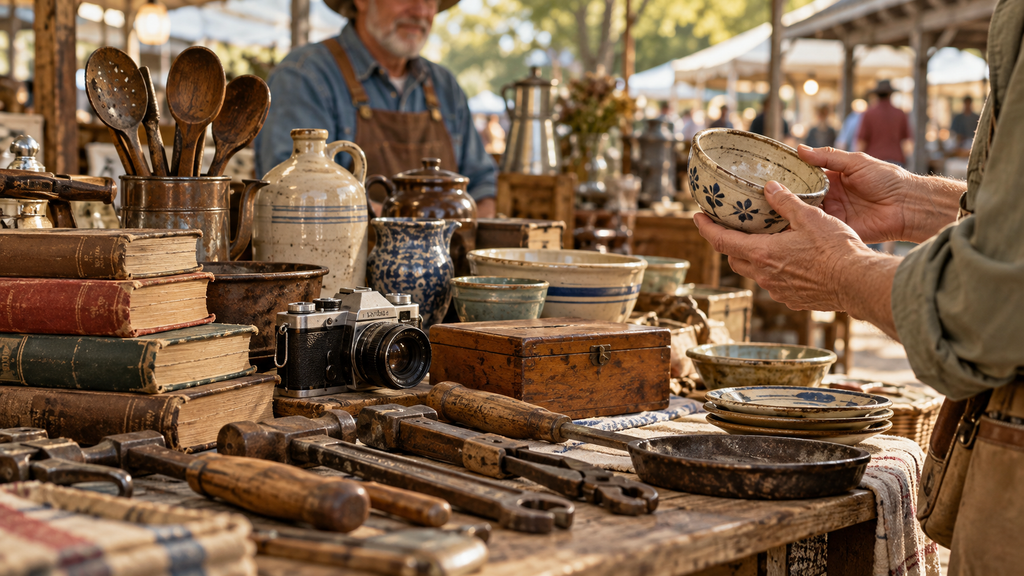
Secondhand markets offer a kind of time travel.
An old baking dish may recall a family kitchen. A hand tool may show the wear of years spent doing one job well. A stack of local papers or postcards can preserve the names of businesses and places that no longer exist. Furniture may carry the proportions and construction of another era, even when no one knows precisely where it began.
Not every old object is rare. Not every item has historical importance. Not every seller knows its full story.
But the setting encourages a different relationship with material things.
Instead of asking only, “Is this new?” shoppers begin asking:
- Does it still work?
- Can it be repaired?
- Who made it?
- What was it used for?
- Is the quality better than something newly manufactured?
- Could it serve a different purpose now?
- Does it remind me of someone?
- Is there enough of its story left to make it meaningful?
For someone furnishing a home after a move, that can be liberating. A new home does not have to be filled entirely with new objects. It can develop character slowly, through pieces discovered one at a time.
The result may not match a furniture showroom.
It may feel far more personal.
Produce, Food and the Farmers Market Inside the Flea Market
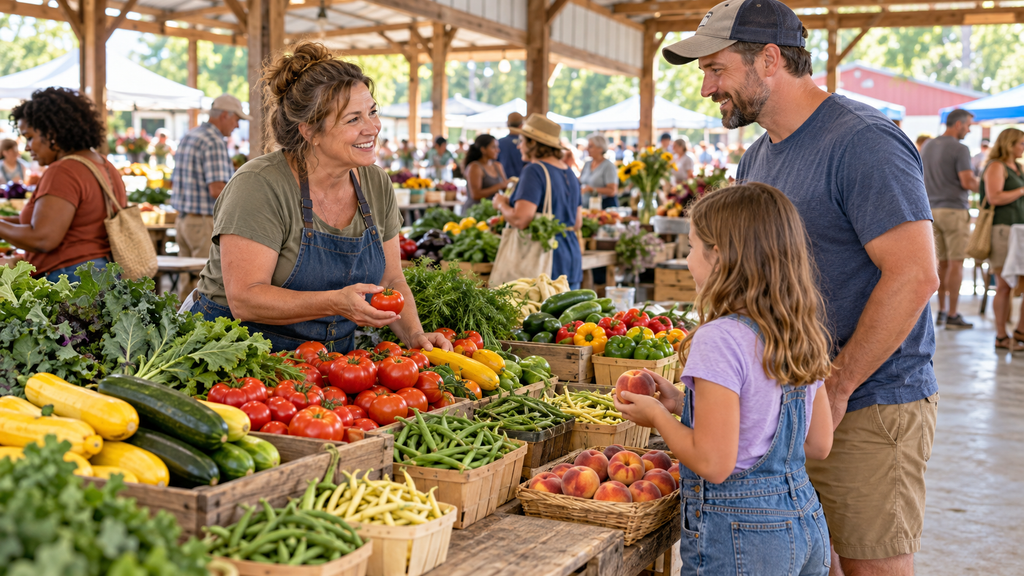
The official name is the Anderson Jockey Lot and Farmers Market, and that final phrase matters.
Fresh produce and food connect the market to another long-standing form of regional commerce. Depending on season and vendor participation, shoppers may encounter fruits, vegetables or other food products alongside the market’s new, used, practical and collectible merchandise.
That mix makes sense.
Historically, community markets have rarely separated life into clean modern retail categories. Food, tools, household goods, animals, clothing, repairs, conversation and commerce have often occupied the same public space.
At the Jockey Lot, a shopper can move from objects with decades of history to produce that reflects the immediate season.
The experience connects preservation and renewal: something grown this year, something made recently, something used for years and something waiting to become useful again.
Food also gives people a reason to linger. A shopping trip becomes part of the day rather than a quick transaction. Families take breaks. Regulars develop favorites. Conversations continue away from the tables where they began.
Specific vendors and available food can change, so this article should not promise a particular dish or product. The reliable advice is to arrive curious—and verify any must-have item with the market or vendor before making a special trip.
A Low-Barrier Place to Test a Small-Business Idea
The Jockey Lot is not only a place where customers look for discoveries. It also creates an entry point for sellers.
The market advertises daily and longer-term rental options for outdoor spaces, indoor spaces, and containers, although prices and availability should always be confirmed directly before making plans. Its vendor structure allows people to sell without opening a conventional storefront. jockeylot.com
That lower barrier can matter.
A seller might use a market space to:
- Test whether customers respond to a product
- Learn how people discuss and evaluate an item
- Experiment with pricing
- Build repeat customers
- Move used inventory
- Turn a collecting interest into income
- Introduce handmade work
- Develop confidence speaking with buyers
- Learn which products deserve further investment
A folding table does not automatically become a successful business. Vendors still face the work of sourcing merchandise, understanding costs, presenting products, collecting payment, managing inventory, and returning consistently enough for people to remember them.
But the market gives an idea of where to begin.
That makes it part of Anderson County’s small-business landscape, even when the enterprises operating within it are modest, part-time, or still taking shape.
Some businesses begin with a formal launch plan.
Others begin when a shopper returns to the same table and asks, “Will you have more of these next weekend?”

What Newcomers Can Learn by Watching
Relocation research tends to emphasize measurable facts: housing prices, employment, schools, taxes, utilities, and commute times.
Those facts are essential. They do not tell you everything.
They do not tell you what people do with an unhurried morning, which places families revisit, or how residents talk to one another when no formal program is directing the interaction.
A place like the Jockey Lot supplies those softer clues.
Watch the pace. Notice which tables attract long conversations. Listen to the recommendations people exchange. Pay attention to the range of ages, interests, and reasons for attending. Observe how newcomers ask questions and how regulars move with the confidence of people who already know the terrain.
You do not have to buy anything to begin understanding the place.
That makes the Jockey Lot an unusually accessible introduction to Anderson County. There is no tour to schedule, no formal membership to secure, and no expectation that you already know what you are doing.
You can arrive, walk and look.
For someone who has recently moved, that low-pressure participation can be more valuable than it sounds. Belonging rarely arrives in one grand moment. It develops through repetition—finding a route, recognizing a face, learning which weekend traditions feel natural and returning often enough that the unfamiliar begins to settle into place.
Why Regulars Return When They Do Not Need Anything
The practical explanation for visiting a flea market is that you need or want something.
The cultural explanation is more complicated.
People return because the inventory changes. Because searching is enjoyable. Because a particular seller may have something new. Because the walk itself has become familiar. Because the market provides conversation, movement, memory and the possibility of surprise.
A regular visitor may know which sections to enter first, when favorite dealers tend to arrive, and which kinds of items require an early start. Those habits are not printed on the market map. They are learned through repetition.
That is how a public marketplace becomes a personal tradition.
The object brought home may be useful, beautiful, funny, or impossible to explain to anyone who was not there. But even an empty-handed visit can still feel worthwhile when the real purpose was to look, talk, and see what the weekend produced.
The Jockey Lot offers something increasingly uncommon: a large physical marketplace that cannot be fully filtered, searched, or predicted before you arrive.
You have to encounter it.
The Difference Between History and Lore
A place operating since 1974 will naturally accumulate stories.
Some can be documented through business records, newspaper archives, photographs, and people directly involved in the market’s history. Others belong to the more fluid world of local lore—favorite finds, remembered dealers, changing sections, legendary bargains and claims repeated often enough to become part of the place’s reputation.
Both kinds of stories matter, but they should not be presented as though they carry the same evidence.
The market’s official sources can establish its address, published schedule, business history and current operating information. Longtime dealers and shoppers can describe their own memories and experiences. Historical archives can help confirm dates, ownership changes and major developments.
What no responsible article should do is turn a colorful memory into a universal fact.
That distinction creates an exciting opportunity for future reporting. The Jockey Lot’s deepest story may emerge through interviews with the people who have returned for decades:
- What did the market look like on their first visit?
- Which parts have changed?
- What has remained remarkably familiar?
- Which dealer or product category do they still remember?
- When did a weekend outing become a family tradition?
- What does “everybody knows” actually mean when the records are examined?
The launch story can introduce the ritual.
The people who lived it can tell us what the ritual has meant.
Planning a First Visit
The Anderson Jockey Lot currently publishes the following information:
Address:
4530 Highway 29 North
Belton, South Carolina
Published market hours:
- Saturday: 7 a.m.–5 p.m.
- Sunday: 8 a.m.–5 p.m.
- Open weekends throughout the year, rain or shine
Phone: 864-224-2027
Email: info@jockeylot.com
Official website: jockeylot.com
These details were verified through the official market website in September 2026, but operating conditions can change. Confirm current hours, policies, weather information and any accessibility questions before making a special trip. jockeylot.com
Before you go
- Wear comfortable walking shoes.
- Check the weather and dress for outdoor conditions.
- Review the official market layout if large spaces are difficult for you to navigate.
- Bring water according to your needs.
- Assume payment methods may vary by seller.
- Ask before photographing people, booths, or privately owned merchandise.
- Inspect secondhand items carefully before purchasing.
- Confirm current rules for pets, service animals, carts, and restricted merchandise directly with the market.
- Give yourself permission to see only part of it.
- If one particular vendor or item is the reason for your trip, verify availability first.
Most importantly, do not approach your first visit as though you must master the place.
Go as an observer.
The Hidden Gem Is the Habit of Looking
The Anderson Jockey Lot is not hidden in the usual sense. It has a public address, an official website, and a reputation that has traveled across generations.
What newcomers may miss is the role it plays.
It is a marketplace where people can start small, search slowly, sell independently, and encounter objects outside the carefully controlled environment of conventional retail. It is a place where a used tool can return to work, a piece of furniture can enter a new home, a seller can test a business idea, and a family can build a weekend tradition around the simple question, “What do you think we’ll find today?”
The Jockey Lot does not need to be polished into something else to be valuable.
Its personality comes from variety, movement, negotiation, memory, and the freedom to wander without knowing exactly what waits around the next corner.
That is what makes it an Anderson Hidden Gem.
Not one rare object.
Not one remarkable bargain.
Not one booth everyone must visit.
The hidden gem is the market’s continuing invitation to come back, look again and discover that the experience has changed because the tables—and perhaps the person walking between them—are never quite the same twice.
Experience It for Yourself
Choose a weekend morning, confirm the current market information, and begin with one manageable section.
Arrive early enough to wander without rushing. Ask a seller a thoughtful question. Look closely at something you would normally pass. Notice what families carry, what collectors study, and which conversations seem to continue between weekends.
You may leave with a useful object, a strange treasure, a bag of produce, or nothing at all.
But you will have seen a side of Anderson County that cannot be understood from a housing report or a map.
You will have stepped into one of its living rituals.
Finding Your Place
Feeling at home begins with discovering the people, places, and traditions that give a community its character. Explore more of the Upstate—and begin finding your place within it.
Editorial Production Note
This story was developed by the Greenville Upstate Life Media Editorial Team with assistance from Calvin Lee, our AI-assisted local-history, practical-discovery and community-traditions editorial persona, and Sierra Blake, our AI-assisted community-stories and belonging editorial persona. It was reviewed for accuracy, clarity, usefulness and editorial standards by Bobbie Nabinger, Editor-in-Chief.
AI Image Disclosure
Unless otherwise identified or credited, the images accompanying this article are AI-assisted editorial illustrations created for Greenville Upstate Life Media to represent the setting, atmosphere and themes of the featured story. They are not documentary photographs of the actual people, businesses, organizations, locations, events or activities described.
Sources and Further Reading
- Anderson Jockey Lot and Farmers Market
- Anderson Jockey Lot: About Us
- Anderson Jockey Lot: Market Layout
- Anderson Jockey Lot: Vendor Rental Information
- Visit Anderson: Going Antiquing
This article provides general community, visitor, and relocation information. Market hours, vendors, merchandise, rental prices, policies and accessibility conditions may change. Confirm current information directly with the Anderson Jockey Lot before visiting, selling or making travel plans. Greenville Upstate Life Media does not inspect, authenticate, value, guarantee or endorse merchandise offered by individual sellers