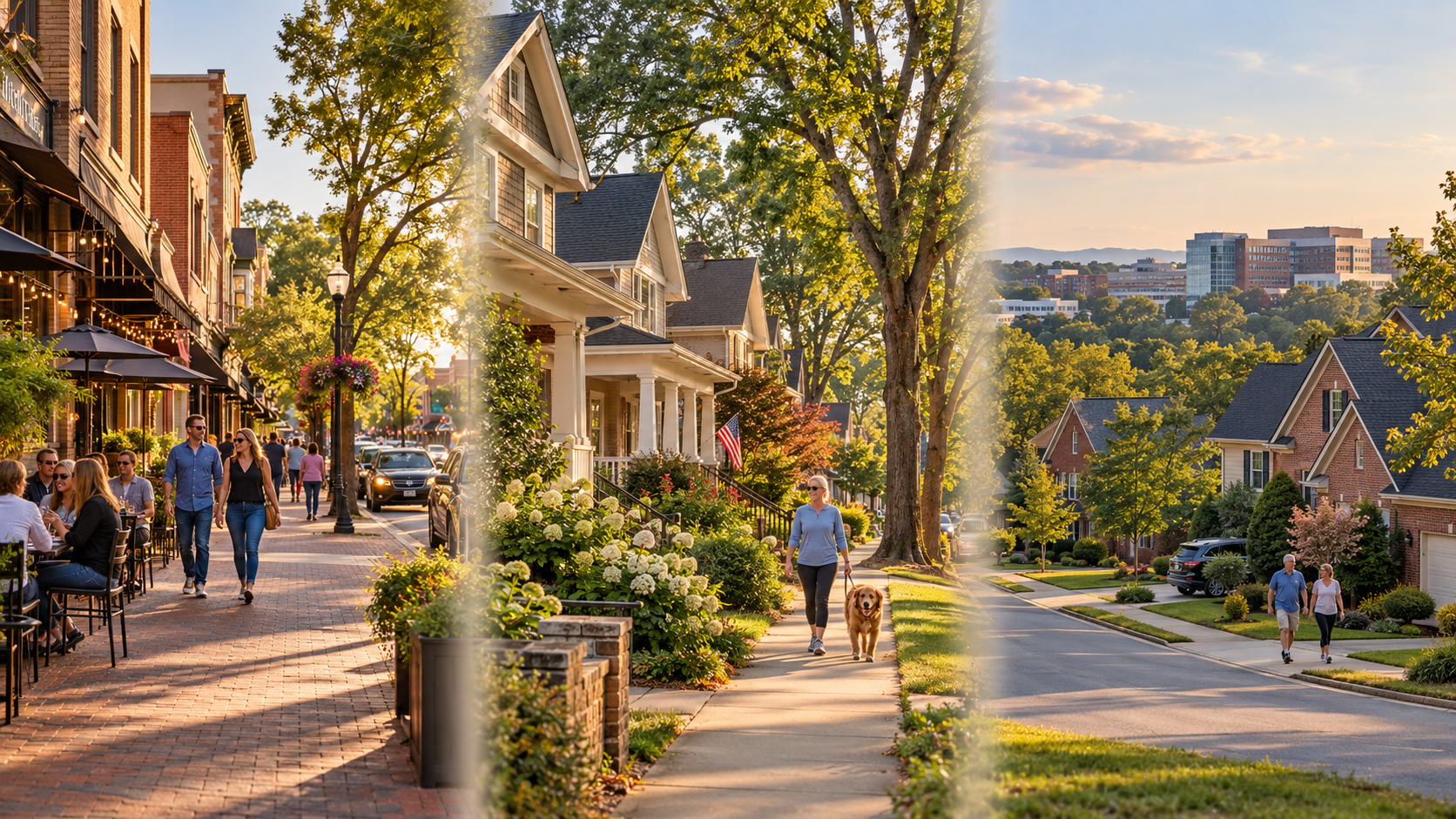


Where you live in Greenville can shape whether your ordinary Tuesday begins with a walk down Main Street, coffee beneath a canopy of mature trees, or a short drive that places doctors, groceries, and major roads within easy reach.
Greenville makes a dazzling first impression.
Visitors remember the curve of the Liberty Bridge, the rush of the Reedy River and the restaurant tables spilling toward Main Street. They drive through close-in neighborhoods where deep porches sit beneath old oaks. Farther east, they discover another kind of appeal: established homes surrounded by medical offices, shopping, restaurants, and roads leading toward the airport and the rest of the Upstate.
All three can produce a wonderful Greenville life. They simply do not produce the same life.
That distinction matters when you are relocating. It is easy to fall for a beautiful kitchen, a famous ZIP code or a charming street without asking whether the location supports the way you actually spend your days.
Do you want to step outside and immediately feel part of the city?
Would you rather come home to an older house on a quieter residential street?
Or does daily convenience—especially access to healthcare, shopping, and regional employment—matter more than being able to walk to dinner?
Instead of asking which Greenville area is “best,” begin with a more useful question:
Which version of Greenville feels most like the life you are trying to build?
Option One: Put Greenville Outside Your Front Door
Imagine closing your laptop late on a Thursday afternoon and realizing you do not need to get into a car.
Dinner is a few blocks away. A performance is beginning at the Peace Center. Falls Park is catching the last gold light of the day, and the Swamp Rabbit Trail is busy with walkers and cyclists making their way along the Reedy River.
This is the promise of living in or immediately around downtown Greenville: the city becomes part of your daily routine rather than a destination you visit.
Downtown offers Greenville’s strongest concentration of walkable dining, cultural attractions, public spaces, events, and urban housing. Apartments, condominiums, lofts and mixed-use buildings create options for renters, professionals, downsizers and people who want to test Greenville before making a longer-term purchase.
Falls Park sits at 601 South Main Street, while the city’s trail network connects downtown with additional parks and destinations. Greenville also operates free downtown trolley routes during designated service periods, although routes and operating hours should always be checked before relying on them. connections.greenvillesc.gov
For the right person, this can feel wonderfully liberating.
You may be able to walk to coffee, dinner, entertainment, or work. Visitors are easier to entertain because much of what they came to see is already nearby. A smaller home may feel less limiting when parks, patios, trails and cultural venues function like an extended living room.
But walkability is not a free amenity. It comes with trade-offs.

What downtown asks you to accept
Living near the center of an active city can mean:
- More event traffic and occasional road closures
- Street activity and noise that change from block to block
- Less private outdoor space
- Parking arrangements that may be separate from the residence
- Condominium or building fees
- Rules governing pets, rentals, renovations, and shared spaces
- A higher price for location relative to the amount of private space
Downtown is also not synonymous with the entire 29601 ZIP code. “Downtown,” “West End,” “Pettigru” and other nearby names can describe different districts or market areas. Never assume a property offers a particular downtown routine simply because its listing uses a recognizable ZIP code.
Walk it yourself.
Visit in the morning, during a weeknight, and on an event weekend. Time the trip to the places you expect to use. Stand inside the unit and listen. Locate the parking space. Read the condominium documents, fee schedule, and rental restrictions.
The downtown question is not merely, “Can I walk somewhere?”
It is, “Can I comfortably live with everything else that makes this walk possible?”
Option Two: Let the House and Neighborhood Tell Part of the Story
Now picture a different arrival home.
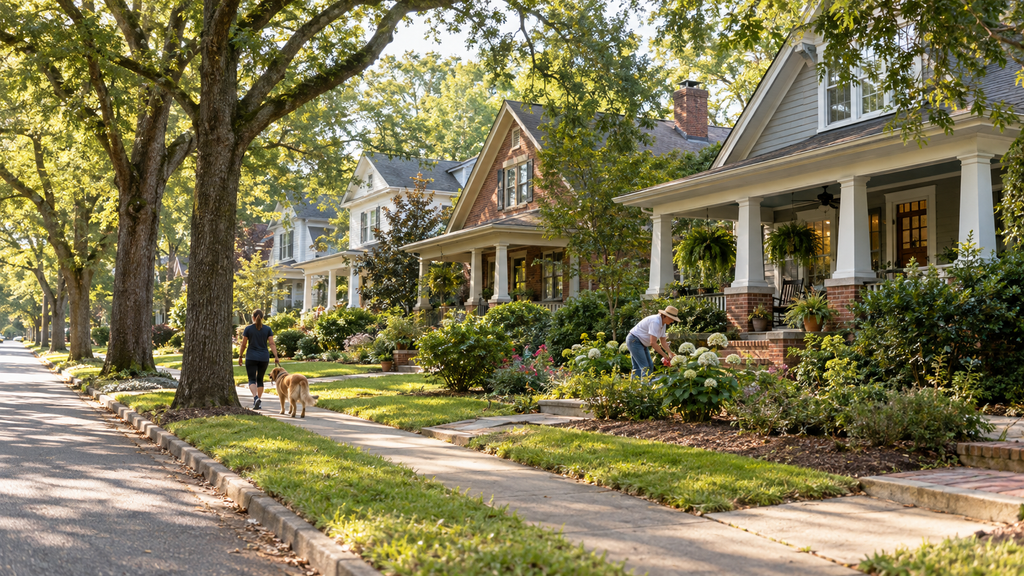
Instead of entering a lobby or parking garage, you turn onto a residential street shaded by mature trees. The houses do not all look alike. One has a broad Craftsman porch. Another carries the proportions of an earlier Greenville. Renovations, additions and newer infill appear beside homes that have been part of the neighborhood for generations.
This is the version of Greenville that attracts people to established close-in areas such as North Main, Augusta Road and Overbrook.
These communities appeal to buyers who want neighborhood identity, architectural character and relatively convenient access to downtown without living in the middle of its event rhythm. Depending on the exact location, residents may find parks, neighborhood businesses and selected walking or cycling connections nearby.
North Main, for example, offers a calmer residential setting close to downtown, with neighborhood parks and an evolving connection to the Swamp Rabbit Trail network. The city identifies North Main Rotary Park as a neighborhood park, and its North Main Connector project was designed to create a neighborhood link to the trail’s Orange Line. Greenville, SC – Official Website
Overbrook presents another layer of Greenville character. The City of Greenville traces the neighborhood’s development to the expansion of the trolley line, an origin still reflected in its close-in location and early-20th-century housing. greenvillesc.gov
Augusta Road adds its own personality: an established residential market south of downtown, with mature housing, neighborhood commerce and convenient access to major healthcare and employment destinations.
These areas are often grouped together in relocation conversations because they offer “character homes.” Yet they are not interchangeable—and character is not merely an architectural style.
It can mean creaking floors, deep porches, mature landscaping, previous renovations and rooms shaped for a different era. It can also mean electrical panels, roofs, drainage, foundations, plumbing or HVAC systems that deserve a closer look.
The romance and responsibility of an older home
An established home can offer qualities that are difficult to reproduce:
- A distinct architectural identity
- Mature trees and landscaping
- Residential streets with a long-established rhythm
- Proximity to central Greenville without downtown density
- Renovations that preserve original details
- A stronger sense that the house belongs specifically to its setting
It may also require more stewardship.
A beautifully updated kitchen does not reveal what is happening beneath the crawlspace. Fresh paint does not document the age of the wiring. A majestic tree may provide shade while also requiring professional care. Even a thoroughly renovated home deserves an inspection that looks beyond finishes.
Historic terminology requires care, too. A property can be old, historically interesting, or located in a widely recognized older neighborhood without being inside an official preservation overlay. Conversely, a property inside a designated district may be subject to rules affecting exterior changes. The City of Greenville maintains official historic-district information and permitting guidance; buyers should verify the individual property rather than relying on listing language. Greenville, SC – Official Website
This lifestyle is often ideal for someone who says:
“I want to feel connected to Greenville, but I want home to feel like a retreat from it.”
The important test is not whether you love the house during a showing. It is whether you also want the maintenance, traffic pattern, lot responsibilities, and block-by-block mobility that come with it.

Option Three: Organize Daily Life Around Medical and Everyday Convenience
Not every satisfying Greenville life begins with a sidewalk or a century-old porch.
For many households, convenience is the luxury.
It may mean leaving a medical appointment and picking up groceries on the way home. It may mean reaching several employment corridors without crossing downtown. It may mean living close to specialists, pharmacies, restaurants, shopping, and roads that connect with Interstate 85, Interstate 385, and Greenville-Spartanburg International Airport.
That practical version of Greenville is one reason the Eastside receives so much relocation attention.
The Eastside is not a municipality, one subdivision or one school zone. It is a broad consumer market made up of distinct residential pockets around heavily used corridors such as Pelham Road, Haywood Road and East North Street.
Its appeal is less about one postcard-perfect identity and more about the number of everyday needs that can be reached by car.
Healthcare is an especially important part of that equation. Bon Secours St. Francis Eastside operates in the 29615 area, and Prisma Health’s Patewood campus brings medical and specialty services to the same broader side of Greenville. bonsecours.com
For healthcare professionals, households managing recurring appointments, active older adults or caregivers coordinating services for family members, that proximity can materially change a week.
Eastside living can also support a rent-first strategy. Apartments, townhomes, detached rentals and maintenance-light housing give newcomers opportunities to test commutes, traffic and service patterns before choosing a permanent home.

What convenience looks like in real life
The Eastside may fit you if your priorities sound like these:
- “I want several medical options within a manageable drive.”
- “I travel frequently and care about regional road and airport access.”
- “I would rather simplify errands than walk to entertainment.”
- “I want established housing without taking on a significantly older home.”
- “I need rental choices while I learn Greenville.”
- “I care more about reaching several parts of the Upstate than living near one central district.”
The tradeoff is that much of this lifestyle remains car-oriented.
A grocery store may be close in miles but unpleasant to reach on foot. Two homes carrying the same broad Eastside label can produce very different peak-hour drives. A location that works beautifully for a Patewood employee may not create the same routine for someone commuting south on Interstate 85.
Do not test Eastside convenience on an empty Sunday morning. Drive the actual route when you expect to use it.
Convenience should be measured by your calendar—not by the number of pins displayed on a map.
Three Greenville Lifestyles at a Glance
| If you value… | Begin by exploring… | What you may gain | What to examine carefully |
|---|---|---|---|
| Walkability, culture and an energetic social setting | Downtown Greenville | Restaurants, parks, events and city life close to home | Parking, noise, building fees, private space and event activity |
| Architectural character and a neighborhood-first feeling | North Main, Augusta Road and Overbrook | Mature streets, distinctive homes and close-in access | Older systems, renovation quality, maintenance and exact historic status |
| Healthcare, shopping and regional road access | Eastside Greenville | Medical proximity, service convenience, rental depth and easier regional movement | Traffic, car dependence, broad market labels and exact commute patterns |
This is not a ranking. It is a translation tool.
The right choice depends on what you want your ordinary days—not just your best weekends—to feel like.
The “Tuesday Test”: A Better Way to Compare Greenville Addresses
Before becoming attached to a property, imagine one completely unremarkable Tuesday.
Where will you wake up? Where will you work? Who needs to reach school, childcare, medical care, or an airport? Will you cook, meet a friend downtown or pick up dinner near home? Do you need to walk a dog after dark? Where will visitors park? How much house and yard will you realistically maintain?
Then test the address against that day.
If you are considering downtown
- Walk from the residence to your actual destinations.
- Confirm whether parking is deeded, assigned, leased, or public.
- Visit during an event or busy weekend.
- Review association fees, reserves, rules, and pending assessments.
- Ask how deliveries, guests, pets, and bicycles are handled.
- Listen from inside the residence at the times you expect to be home.
If you are considering a character neighborhood
- Order an inspection appropriate for the home’s age and construction.
- Ask for permits and documentation for major renovations.
- Examine drainage, trees, roof age, electrical service, and crawlspace conditions.
- Verify whether the property is inside a formal historic district.
- Test its actual walkability rather than relying on the neighborhood’s reputation.
- Price the ongoing maintenance—not only the mortgage.
If you are considering the Eastside
- Drive your commute during realistic traffic.
- Identify the medical facilities and specialists you would actually use.
- Compare weekday access to groceries, pharmacies, and other routine services.
- Verify subdivision or condominium rules.
- If renting, confirm fees, utility responsibilities, parking and lease terms.
- Decide whether the convenience compensates for a more car-dependent routine.
A Greenville Name Is Not an Address-Level Guarantee
Broad neighborhood labels are helpful for beginning a search. They are not precise enough to finish one.
A Greenville mailing address does not necessarily mean the property is inside the City of Greenville. A ZIP code does not establish a neighborhood boundary. The Eastside is not one school attendance area. North Main is not identical to 29609, and Augusta Road is not interchangeable with every address in 29605.
School assignments should always be checked using the specific street address. Greenville County Schools provides an official address-based locator and cautions that assignments may change. Greenville County Schools
The same exact-address rule applies to:
- City versus unincorporated county jurisdiction
- Property taxes and municipal services
- School assignments
- Water and wastewater providers
- Trash collection
- Electric and gas service
- Internet availability
- Historic-district status
- Association obligations
- Commute and traffic conditions
A beautiful area may begin the conversation. The address must complete it.
Use our Greenville ADDRESS VERIFICATION CHECKLIST before relying on a ZIP code, neighborhood name or listing description.

So, Which Greenville Should You Choose?
Choose downtown if the city itself feels like an amenity you want to use frequently—and if you are comfortable exchanging some space, quiet, and parking simplicity for that access.
Choose an established character neighborhood if you want home and neighborhood identity to play a larger role in your life—and if you are prepared to understand the responsibilities that can accompany an older property.
Choose the Eastside if medical access, shopping, rentals and regional movement would make your days noticeably easier—and if a car-oriented routine feels like a reasonable exchange.
You may also discover that you belong somewhere between the three.
Perhaps you want a North Main address close enough for an occasional walk or bike ride, without living directly above downtown activity. Perhaps you want Eastside convenience but prefer an older ranch with mature landscaping. Perhaps renting downtown for a year will tell you whether the urban lifestyle is exciting or exhausting before you buy.
That is not indecision. It is good relocation planning.
Greenville does not offer one correct way to feel at home. It offers several different ways to arrange a life.
The most promising place is the one that makes your real routine feel more natural—not the one that simply looks best during a weekend visit.
Your Next Step
Choose the Greenville lifestyle that currently sounds most like you:
- City at your doorstep: Explore Downtown Greenville.
- Character around the corner: Compare North Main, Augusta Road and Overbrook.
- Convenience built into the week: Explore Eastside Greenville.
Then compare at least two specific addresses from different lifestyle patterns. Visit each one during the hours when your routine would place the most pressure on the location.
Suggested future internal links: Insert links to the corresponding neighborhood pages as each page becomes available.
Finding Your Place
The right move begins with the right questions. Explore the communities, practical guidance and local research that can help you choose with greater confidence.
Editorial Production Note
This story was developed by the Greenville Upstate Life Media Editorial Team with assistance from Georgia Wren, our AI-assisted relocation editorial persona, and Marcus Ramirez, our AI-assisted practical-planning editorial persona. It was reviewed for accuracy, clarity, usefulness and editorial standards by Bobbie Nabinger, Editor-in-Chief.
AI-Assisted Image Disclosure
Unless otherwise identified or credited, the images accompanying this article are AI-assisted editorial illustrations created for Greenville Upstate Life Media to represent the setting, atmosphere and themes of the featured story. They are not documentary photographs of the actual people, businesses, organizations, locations, events or activities described.
Sources and Further Reading
- City of Greenville — Explore Downtown
- City of Greenville — Falls Park
- City of Greenville — Main Street Trolley
- City of Greenville — Historic Districts
- City of Greenville — Overbrook Historic District
- City of Greenville — North Main Rotary Park
- City of Greenville — North Main Connection to the Swamp Rabbit Trail
- Greenville County Schools — Find Your School by Address
- Bon Secours — St. Francis Eastside
- Prisma Health — Upstate